
Basic Page
Basic Page
Published on
2019 Oct 18National workshop to validate regional plans for the implementation of the national strategy and action plan on biodiversity
Thursday, August 29, 2013, in the premises of the Hotel le Paradis in Kayanza, a “Workshop to validate Regional Plans for the implementation of the National Strategy and Action Plan on Biodiversity in the ecological zones of Mumirwa and Congo-Nile Ridge, the Congo-Nile Ridge, the Imbo Plain and the Bugesera Depression” was held. This workshop is part of a long process that Burundi has begun since May 2012, when Burundi started the implementation of the project “Revision of the National Strategy and Action Plan on Biological Diversity and Development of the 5th National Report to the Convention on Biological Diversity”. The documents to be validated were prepared through regional consultations conducted by national associations and whose mission was to prepare these regional plans.
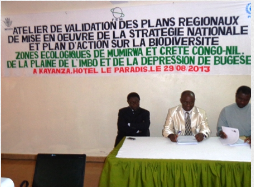
The work of the workshop was opened by the opening speech delivered by the Director General of INECN, representing the Minister of Water, Environment, Land Use Planning and Urban Planning. Through his speech, the Director General of INECN noted that biodiversity and natural resources as well as agro-biodiversity are in danger, as evidenced by the disappearance of forests due to incessant illegal logging, bush fires, the disappearance of local species that have long been domesticated, the disappearance of local species that have long been domesticated, the uncontrolled introduction of GMOs, the proliferation of water hyacinth and Lantana camara.
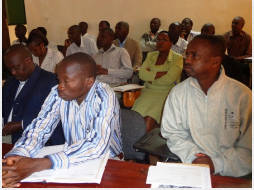
Before finishing his speech, he informed the participants that this workshop marks a decisive step towards the integration of biodiversity issues into various development tools at the provincial, municipal and hill levels for the implementation of the National Strategy and Action Plan on Biodiversity and he invited the participants to be strongly and effectively involved in this work of validating these plans. After the opening speech, the participants followed three successive presentations on:
- The Regional Plan for the implementation of the National Strategy and Action Plan on Biodiversity in the ecological zone of the Bugesera Depression;
- The Regional Plan for the implementation of the National Strategy and Action Plan on Biodiversity in Mumirwa and the Congo-Nile Ridge; - The Regional Plan for the implementation of the National Strategy and Action Plan on Biodiversity in the Imbo Plain ecological zone;
- The Regional Plan for the implementation of the National Strategy and Action Plan on Biodiversity in the Imbo Plain ecological zone.
The content of these presentations focused on the status and trends of biodiversity in these ecological areas, on the role of biodiversity in human well-being, on the causes of biodiversity degradation, on the existing potential to reduce the degradation of biodiversity, on the existing opportunities to reduce the degradation of biodiversity, on the constraints, gaps and needs at the regional level on the constraints, gaps and needs at the regional level for the implementation of the Strategy as well as the Action Plan.
After the presentations, participants had the opportunity to comment, discuss, and ask questions about all the presentations. The questions and comments were related to:
- The recommendation and large-scale use of chemical fertilizers by DPAEs, although these are among the pollutants;
- The unknown area of protected areas in general and of the Murehe reserve in particular;
- Tobacco cultivation considered to be an industrial crop when it is not;
- The non-recognition and absence of mention of the newly emerging Lake Dogodogo in the list of other lakes in the ecological zone of the plain of the Imbo; - The questions
criteria for determining the biodiversity richness of the Rusizi National Park.
To all these questions, the presenters provided satisfactory clarifications and answers.
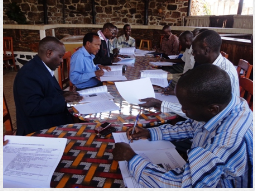
This exchange and discussion session was followed by committee work. These took place in three groups according to ecological zones and participants were asked to comment, analyze deeply the document and make recommendations.
At the level of the first group that worked on the ecological zone of Imbo Plain, the recommendations issued are as follows:
- Harmonize the structures of the document taking into account the observations made in the group;
Reformulate the paragraph on page 25 taking into account environmental issues (this is the case of pretreatment, treatment and small processing units for palm oil, tomato and tobacco processing);
- For seed centers, add the seed centers of Karurama and Mparambo en Cibitoke as well as the ISABU Mparambo research station; - Mention all the omitted DPAEs (Bubano Cibitoke, Makamba);
- Mention the means of preventing and combating diseases of
banana trees;
- Adapt objectives 5 and 6 at the regional level;
- Strengthen the capacities of actors in the region;
- Ensure intersectoral collaboration between decentralized State services.
At the level of the second group that worked on the ecological zones of Mumirwa and Congo Nile Ridge, the reformulated recommendations are as follows:
- Review the document in order to correct typing errors, reformulate the objectives taking into account the observations given; - Define priorities based on the related objectives; - Define priorities based on the related objectives; - Define priorities based on the related objectives; - Carefully separate the actions to be carried out at the national and regional levels by removing all actions of a national nature;
- Redefine the objectives taking into account the observations given; - Define priorities based on the related objectives;
- Define priorities based on the related objectives; - Separate the actions to be carried out at the national and regional levels well by removing all national actions; - Redefine the Objectives because
some are confused about the actions to be taken;
- At the level of constraints and threats, add the uncontrolled extraction of construction materials, the absorption of local races by new introductions;
- Title the table on page 46 and add the column of strategic axes and expected results by making them correspond to the objectives.
As for the third group that worked on the ecological zone of the Bugesera Depression, the recommendations issued are as follows:
- With regard to illegal mining in the Murehe reserve, withdraw the authorizations granted to operators by the Ministry of Energy and Mines;
- Conduct internal surveillance at the level of Burundi and cooperative surveillance with Rwanda in the case of introduction of fish species; - Integrate and specify the responsibilities of the committees;
- Integrate and specify the responsibilities of the committees Biodiversity protection hills on the Muyinga part, especially in Giteranyi;
- Insert the budgeting and calendar columns in the table (page 41) relating to the action plan;
- Apply the law relating to the protection of buffer zones.
The documents were validated provided that the recommendations issued were incorporated into the documents.