Document
Document
File Name
bulletin-sc-12-inecn.pdfFile Type
PDF DocumentFile Size
3.9 MBCreated Date
2019 Dec 07Updated Date
2019 Dec 07Published on
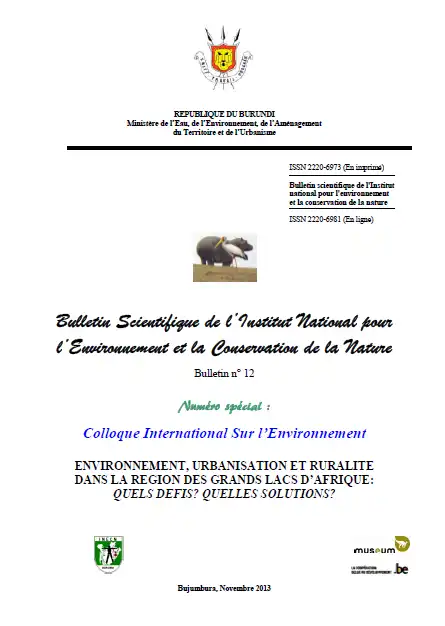
2013 Nov 01Scientific Bulletin of the National Institute for Environment and Nature Conservation: Bulletin No.
Since its birth in 1964, the University of Burundi as a public institution had as its main mission the main mission of high quality training, the promotion of research and scientific innovation in all areas of life.
In this context, the Faculty of Sciences and the Faculty of Agricultural Sciences of the University of Burundi, in collaboration with the French-speaking Universities of Belgium under the leadership of the University Commission for Development (CUD) of the Wallonia-Brussels Community, have initiated and financially supported graduate and postgraduate training programs. These courses have greatly contributed to improving knowledge of terrestrial and aquatic biodiversity in the Great Lakes countries on the one hand, and of the management of liquid and solid waste pollution on the other hand. In addition, these programs have made it possible to understand the combined effects of rural exodus, urban expansion, and policies for the development and opening up of urban and rural territories.
In order to raise public awareness, the University of Burundi, through its Advanced Master's program in Environmental Sciences, organized, on November 8 to 10, 2012, an International Environmental Colloquium around the theme “Environment, Urbanization and Rurality in the Great Lakes Region of Africa: What Challenges?” What solutions?”
The topics developed in this special issue of the INECN Scientific Bulletin include the scientific papers presented in this Colloquium. By publishing this special issue, however, we would like to inform the public and researchers, both national and international, to mobilize to contribute to the mitigation of environmental risks and to predict their effects.
We thank the Research and Innovation Department of the University of Burundi, the University Commission for Development (CUD) through its Advanced Master's program in Environmental Sciences, the Canadian Research Center for International Development (CRDI) and the various banks in Burundi for their financial contributions. These made it possible to welcome and host the various speakers from within Burundi, Belgium and the Democratic Republic of Congo.