
News
News
Published on
2019 Dec 10Meeting of the Scientific and Editorial Committee of the Scientific Bulletin on Environment and Biodiversity
On November 27, 2019, a meeting of the Scientific Committee of the Scientific Committee of the Scientific Bulletin on Environment and Biodiversity in Burundi was held in the office room of the Biodiversity Research Center of the Biodiversity Research Center of the Burundian Office for Environmental Protection (OBPE) located in Jabe. Its objective was to assess the scientific report for the 2018 financial year and to prepare for the publication of the fourth issue.
Were present:
The Director General of the Burundian Office for Environmental Protection (OBPE), The Permanent Secretary of the Ministry of Higher Education and Scientific Research and at the same time Editor-in-Chief of the scientific bulletin, the Professors of University Institutions including the University of Burundi (UB) and the University of Burundi (UB) and of the Ecole Normale Supérieure (ENS) as well as the executives of the OBPE who are members of the scientific committee of the scientific bulletin on the Environment and Biodiversity.
The word of welcome to all participants was delivered by the Director General of OBPE. He talked about the importance of the committee and the role it plays in the publication of research results. He recognized that it is on the basis of research results that knowledge on biodiversity is improving for decision-making in the conservation and sustainable management of biodiversity and in order to promote sustainable socio-economic development. He ended his speech by thanking all the participants who had responded to the invitation, while stressing that their presence demonstrated their determination to advance science, particularly relating to sustainable development.
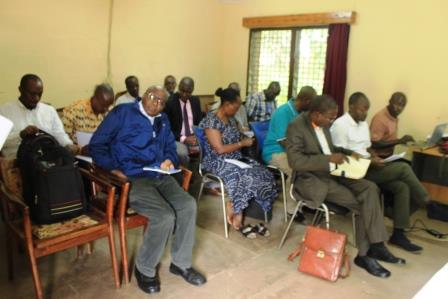
|
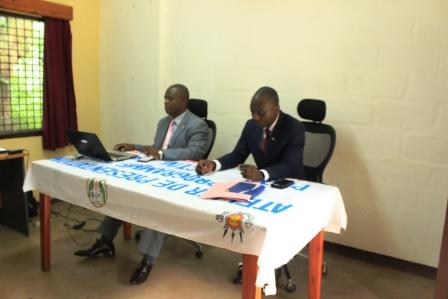
|
| Figure 1a: Overview of participants | Figure 1b: Opening remarks from the CEO of OBPE |
The activities of the workshop continued with the presentation of the results of the publications of the scientific bulletin by its Editor-in-Chief, Mr. Permanent Secretary at the Ministry of Higher Education and Scientific Research Professor BANGIRINAMA Frédéric. He recalled that 12 newsletters had been produced under the former scientific bulletin of the National Institute for the Conservation of Nature (INECN), which was created in May 2006, to which was added a special issue of the conference prepared in 2012. He pointed out that the change from INECN to OBPE also caused the establishment of the Scientific Bulletin on Environment and Biodiversity in 2016. The overall objective of creating this Bulletin therefore remains to set up an information system to disseminate scientific knowledge on biodiversity across the continent, he says. In this newsletter, two issues have already been published in addition to the third issue published in tribute to the late NZIGIDAHERA Benoît in 2019.
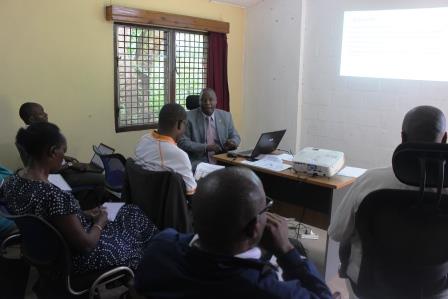
|
| Figure 2: Opening remarks from the CEO of OBPE |
He then came back to the authors of the 80 articles that appeared in the various newsletters for which Mr. Feu NZIGIDAHERA Benoît won the lead with 22 articles.
He also recalled the editorial procedures for publishing in the bulletin on the environment and biodiversity in Burundi, including:
- The Editor-in-Chief, Deputy Editor-in-Chief, and Associate Editors are responsible for deciding whether the submitted manuscript can be published in the newsletter. The Editor-in-Chief or the Deputy Editor-in-Chief in consultation with the Editor concerned with the subject of the submitted article therefore submit to the readers a manuscript already considered important for publication.
- A manuscript must be analyzed by at least two readers from the Scientific Committee. The choice of readers is decided by the Editor-in-Chief, the Deputy Editor-in-Chief and the Associate Editor-in-Chief of the article. If necessary, a manuscript may be submitted to external readers identified by the Editor-in-Chief, Deputy Editor-in-Chief and Associate Editors with the possibility of proposals from members of the Scientific Committee.
- The decision to accept or reject a manuscript based on readers' opinions is the responsibility of the Editor-in-Chief, Deputy Editor-in-Chief, and Associate Editors. No article can be accepted without having undergone the analysis process provided for this newsletter. In the event of a negative position by the readers, the author is called upon to be questioned by the Editor-in-Chief or Deputy Editor-in-Chief in order to take the final decision. The author may be called upon to thoroughly review his text or to carry out additional research activities.
For the 2018 review, the Editor-in-Chief noted the following activities carried out:
- Reviewing and posting the editorial text;
- Updating the scientific committee with a choice of themes and their managers;
- The reception and analysis of article proposals. Ten articles had been submitted, 5 of which appeared in Newsletter No. 3, two were under revision, two were not received for non-compliant format and 1 in English for which a clear decision has not yet been taken;
- The publication of bulletin no. 3.
The presenter noted the following:
- Little influence of manuscripts, which would be linked to the lack of students who currently only report at the end of their studies;
- Manuscripts that do not respect publication formats, especially for authors who work solo;
- Problems with the lack of reviewers of English manuscripts;
- Delays in the revision;
- An increasing visibility of the newsletter because the newsletter has received an article proposal from a foreign author;
- Decrease in collaboration between OBPE and researchers from university and academic institutions.
During this presentation, fruitful exchanges were held where the participants recognized the essential role of researchers from university institutions for their interventions, particularly in the development of national strategy and policy documents in the field of environment and biodiversity. For this purpose, they should be privileged partners to support the implementation of major OBPE projects (Institution in charge of biodiversity management). Despite this, the observation is that it is obvious that there is a lack of bridge, of connection between researchers and decision-makers. Faced with this problem, it is up to the researchers themselves to stand out and highlight the results of their research by organizing advocacy sessions where they will try to invite the authorities concerned to present articles already published and to counter the observation that the authorities do not appear often or are represented, reports will be produced and copies will be sent to them. It will then be a question of working on sensitive themes in particular: on the state of biodiversity in Burundi, the effects of the degradation of habitats and ecosystems as well as of the loss of biodiversity on the socio-economic of Burundi such as the effects of the drying up of rivers, climate change, etc. But also themes that address the relationship between biodiversity and food security.
Regarding the very low publication rate, they pointed out that this is due to the fact that with the new system of internships at the end of the bachelor's degree but that in a period of one year the problem will be solved with the release of the first Master candidates. As for the problem of mastering the English language, participants recognized that the diversity of languages increases the strength of the article, which is measured by the number of people who consult it. To this end, we must take advantage of existing collaborations, particularly at the level of the Community of East African Countries, in order to contact researchers from the region or elsewhere who can contribute as readers and therefore expand the scientific committee. It is up to the thematic managers who are well-versed in this field to already conduct contacts with foreign readers to be included in the scientific committee.
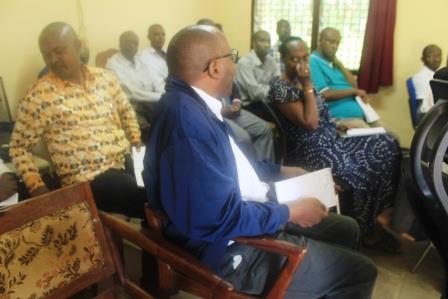
After the discussions, in the form of various and for information purposes, the participants were informed about the preparations for the organization of the NZIGIDAHERA colloquium. scheduled from 13 to 20 March 2020. The objective of this symposium is to perpetuate the work of Mr. NZIGIDAHERA and to pay tribute to his spirit of collaboration and the dissemination of knowledge. One of the results of this conference will be the production of a special issue of the scientific journal.
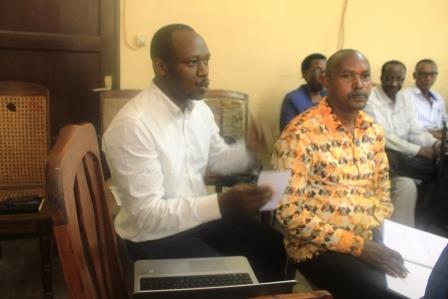
|
|
| Figure 3a: Participant intervention | Figure 3b: Participant intervention |
The participants welcomed the idea of organizing this symposium and recognized that it is only by this one and best way that Mr. Feu NZIGIDAHERA Benoît can be immortalized in recognition of all that he has done for the conservation of biodiversity in Burundi.
During this conference, presentations will be made on the importance of biodiversity and the challenges it represents on the country's socio-economic situation in order to meet the challenges that Burundi awaits if the major project of conservation and sustainable management of biodiversity that Feu NZIGIDAHERA Benoît has been working on all his life is not continued.
On the social side, the participants wanted to recognize the works of Feu NZIGIDAHERA Benoît by thanking the Feu NZIGIDAHERA Benoît family with a gift certified by merit and to recognize the personality of Mr. Feu NZIGIDAHERA Benoît for a takeoff of the best workers for the environment on May 1, 2020, International Labor Day.
Finally, the following recommendations emerged from the various discussions and exchanges:
- Conduct scientific advocacy, in particular by organizing symposiums, forums, etc. to highlight researchers' research results and highlight collaboration between University Institutions and State institutions including the OBPE;
- Identify the number of articles produced in future newsletters with the best work of master students;
- Produce a common argumentative message to be transmitted to research colleagues from other foreign institutions, in particular those from the Community of East African Countries;
- Remain firm and limit analysis times to maintain article production standards to avoid delays in the analysis of submitted articles;
- Initiate collaborations with professors who have a habit of producing articles to monitor the format of presentation of articles in order to reduce the rejection of articles.
Take advantage of the NZIGIDAHERA conference to promote the newsletter and seek the bridge of connection between policies and researchers. To achieve this, it is necessary to raise the event to the level of ministries, i.e. the Ministry of Environment, Agriculture and Livestock and the Ministry of Higher Education and Scientific Research.