News
News
Published on
2019 Dec 10Awareness-raising workshop for key actors to invest in Ecotourism in Burundi
On November 18, 2019, a workshop was held at the Hotel Best Outlook Hotel to raise awareness among key actors to invest in ecotourism in Burundi as part of the program of research, information exchange, awareness-raising and conservation of biodiversity in Burundi established between the Royal Institute of Natural Sciences of Belgium (IRSNB) and the Burundian Office for Environmental Protection (OBPE).
Were present:
The Director General of the National Tourism Office (ONT), the Director General of the Burundian Office for Environmental Protection (OBPE), the Manager of the Kajaga Arboretum, the Representative of the Sectoral Chamber of Hotels and Tourism, the Representatives of Hotels, the Representatives of Hotels, and the various officials of the Ministry of Environment, Agriculture and Livestock, local radio journalists as well as OBPE executives and from ONT.
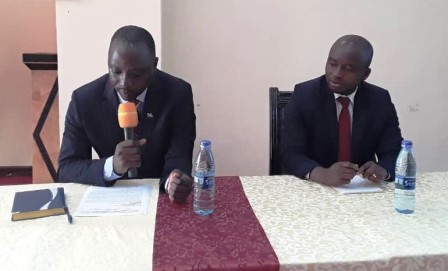
The Director General of OBPE delegated by the Minister of Environment, Agriculture and Livestock, who was duly prevented, opened the workshop (Figure 1a) by thanking the participants for having responded to the invitation.
In his short speech, he specified the objective of the workshop, which is none other than to provide information and clarifications that inspire key actors to take the necessary measures and decisions for the conservation and enhancement of ecosystems in Burundi by taking advantage of the services they provide to humans through Ecotourism.
He defined ecotourism, showed its importance as well as the sectors and elements of biodiversity (fauna and flora) of interest to tourists. Not only does tourism provide economic potential for the country, it also reduces poverty, generates foreign income and contributes to the conservation of ecosystems. Therefore, Burundi has natural, cultural and material sites; and also ecotourism leisure sites.
Currently, the Government of Burundi has made efforts to put in place tools for the conservation and sustainable management of tourist environments in order to take advantage of them. They are focused on certain Protected Areas as well as in the National Parks of KIBIRA and RUVUBU. Nevertheless, the country has some constraints in the development of its ecotourism, namely the allocation of the budget and the availability of qualified and sufficient staff in the field. Hence, the development of domestic tourism remains to be raised at all levels, and efforts must be made to attract foreign investors.
Finally, the workshop aims to improve the field of ecotourism, which is a lever for conservation and the fight against poverty.
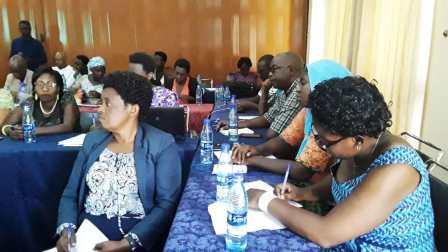
Figure 1b shows the overview of the various workshop participants.
|
|
| Figure 1a: Opening remarks from the CEO of OBPE | Figure 1b: Overview of participants |
Afterwards, the participants followed a presentation session:
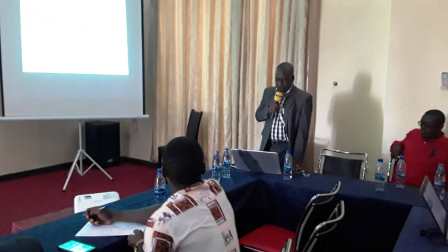
The first presentation entitled “Indicators of the economic value of tourism based on the observation of hippopotamuses in the Delta sector in the RUSIZI National Park” was given by Mr. Fofo Alphonse (Figure 2 a).
He presented the results of a study that was carried out in the Delta sector of the RUSIZI National Park. He reported the geographical location of the RUSIZI National Park, its location, its area, and its floristic richness based on two dominant species, namely Acacia polyacantha and Fragmites mauritianus.
Besides this wealth of flora, he indicated several species of birds, fish, fish, reptiles, amphibians as well as invertebrates constitute a wealth of fauna among which, the most characteristic of the Delta are: the hippopotamus, the birds and the crocodile.
He informed the participants that the Rusizi National Park constitutes a beautiful panoramic landscape, with its tributary to Lake Tanganyika and to the Concorde bridge on the RN4 and is located near the 2 cities, that of Bujumbura and that of Uvira.
As for the state of tourism in Rusizi National Park, there are two tourist guides, two motorized canoes and twin canoes and from the year 2016 to December 2018, the number of visitors has increased accordingly, revenues have increased, he says.
However, he said, tourism in Rusizi National Park faces threats such as the reduction and degradation of animal habitat, poaching, and the reduction of visitors due to insecurity. The lack of quality infrastructure and equipment, the absence of a network with other countries in the sub-region, the low level of participation of local residents and private operators in the sector. Added to this is the inadequacy and/or lack of advertising on the beauty of the Delta sector, the weak capacity of the sector to optimize its attractiveness for both resident and non-resident visitors, the thoughtless improvisation of the activities to develop the main track and the fight against the Lantana Camara, he indicates.
Before finishing his presentation, he gave the Indicators of the economic value of tourism in Rusizi National Park which are as follows:
- A range of indicators of the economic value of tourism in Rusizi National Park with global and specific objectives in this study were identified. It is about:
- the conservation of hippopotamus populations and their habitats;
- strengthening the capacity of the park;
- the increase in tourism revenues in the Delta sector.
He concluded by saying that the Rusizi National Park has obvious tourist potential but that it faces adequate financial, material and human problems as well as the low level of involvement of all stakeholders in the tourism sector to ensure good management of the park.
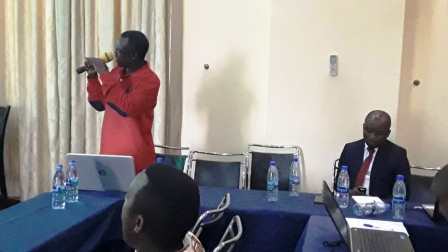
The second presentation entitled “Ecotourism promotion based on the ecosystem services of Burundi's Protected Areas” was given by Mr. MASABO Onesphore (Figure 2b).
He said that the development of ecotourism in Burundi is marginal and has no less significant challenges, namely:
- The lack of ecotourism infrastructure
- The enthusiasm to invest in the sector, the availability of qualified personnel in the field, which still require considerable efforts from stakeholders
- The low budgetary allocation in this area
- The lack of advocacy for the payment of ecosystem and environmental services
- A lack of framework for stakeholder collaboration in the field.
To successfully promote ecotourism products, it is necessary to have good products and adapt a good sales technique through marketing and communication, magazine production, media coverage, and the use of social networks. Exhibiting and organizing fairs on ecotourism, establishing partnerships with other tourism businesses, posting and updating information on the website and promoting domestic ecotourism, he said.
He concluded that tourism is now considered by the Government of Burundi as well as the member states of the East African Community as an essential pillar of national development and above all also a mechanism to reduce poverty, generate foreign income and contribute to the conservation of wildlife. Recent data from Kenya shows that tourism is the second source of foreign exchange after agriculture; represents 11% of the country's GDP and provides 9 to 10% of national employment. Burundi is not yet up to Kenya, but alternative and complementary products to those of other East African countries have already been identified and can be better organized for sale.
|
|
| Figure 2 a: Presentation by Fofo Alphonse | Figure 2 b: Presentation by Masabo Onesphore |
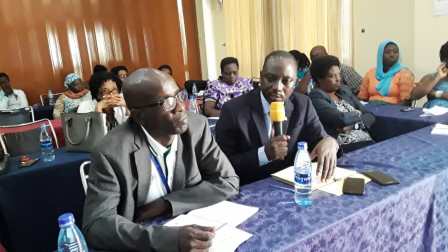
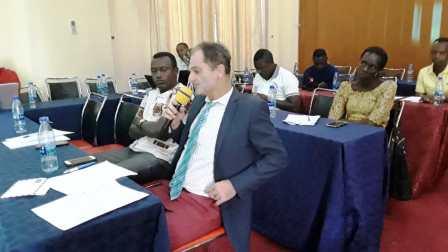
The various interventions by the participants (Figure 3 a & b) noted that the lack of equipped and qualified tourist guides is a threat to ecotourism in Burundi; they asked if there is no way to import exotic animals to enrich Burundi's protected areas in order to increase tourism products. In response to this last question, it was said that prior study is necessary before introducing foreign animals.
|
|
| Figure 3a: Intervention by the CEO of OBPE | Figure 3b: Intervention by the manager of the Kajaga Arboretum |
Recommendations:
Before the end of the workshop, the following recommendations were made:
- Train tourist guides on the job or use the redeployment of already trained staff;
- Organize ecotourism weekends for local residents;
- Repopulate protected areas with small mammals such as squirrels, to make these environments more attractive;
- Recover all animals in captivity;
- Produce a guide plan as a tool for tourist guides;
- Develop community ecotourism;
- Improve successful planning of ecotourism in Burundi;
- Establish a plan to strengthen the technical, material and financial capacities of institutions managing the ecotourism sector linked to ecosystem services in Burundi;
- Engage in partnership agreements with private operators, travelers and local populations;
- Improve and diversify ecotourism products in protected areas;
- Improve the distribution of the economic benefits of tourism for the main stakeholders, in particular local populations;
- Set up an adapted financing system;
- put in place monitoring and evaluation tools;
- Mobilize funds to increase the value of the ecosystem services of the areas - establish monitoring and evaluation tools;
- Create schools that train tourist guides;
- Identify and develop sites of tourist interest and related circuits;
- Identify the various stakeholders for their consultation and collaboration in the development of the ecotourism business;
- Ensure the strengthening of technical and material capacities and the supervision of actors in the promotion of ecotourism;
- develop community ecotourism;
- Organize another workshop bringing together more actors and more partners;
- Establishment of joint ordinances involving the Burundian Office for Environmental Protection (OBPE) and the National Tourism Office (ONT) for the management of tourism;
- Consider repatriating gorillas from Burundi transported to Kenya during the 1993 crisis.
Finally, the Director General of OBPE closed the workshop by once again thanking everyone present and urging them to respond positively to the invitation the next time they are invited.