
Basic Page
Basic Page
Published on
2020 Jan 13Studies on fruit flies (Tephritidae)
In Burundi, we are currently witnessing a worrying proliferation of fruit flies both in forest ecosystems and in agroecosystems. These flies are among the most destructive pests of fruits and vegetables and rank high on the lists. Losses result from direct food damage, weakening by opportunistic pathogenic microbes, and loss of the export market through quarantine restrictions imposed by importing countries to avoid the entry and establishment of these parasites. There is also a significant drop in production due to several species of diptera belonging to the Tephritidae family, which attack fruits and damage crops.
It is this situation that prompted the National Institute for Environment and Nature Conservation (INECN) together with the University of Burundi to conduct a series of studies on these flies in the various agroecological zones of the country. The work of these studies is supervised by Biodiversity Research Manager at INECN M. Sc. Firmin NTIMPIRANGEZA from the Institute of Applied Pedagogy (IPA), Department of Bi Madame Prof. Anastasie GASOGO from the Faculty of Sciences, Department of Biology and Ms. Spéciose GACOREKE Faculty of Agronomy and Bioengineering (FABI),
1. Contribution to the knowledge of fruit flies (Diptera, Tephritidae) in Western Burundi: Case of the city of Bumbura, the Rusizi delta and the Bubanza commune in Bubanza province.
The study area for the present research consisted of quite a few sites selected in this part of the country called Western Burundi. Natural forest ecosystems as well as agroecosystems were explored during the study.
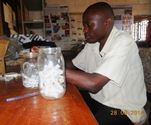 |
During the sampling of the specimens, several collection methods were used and include parapheromone traps installed on fruit trees and the method of incubation in the laboratory of fruits picked or collected at the foot of the trees was also used. Taxonomic analyses required the use of microscopes and rich and varied documentation to achieve the expected results. Both national and foreign scientists have contributed to the completion of this work and the results obtained so far are encouraging. |
| NDAYIZEYE Liévin, student from the University of Burundi taking fruit fly samples |
2. Systematic and ecological study of fruit flies in agricultural areas of Burundi: Case of the municipalities Nyabihanga, Rumonge and Rugombo
The present study concerned the agricultural communities of the municipalities of Burundi mentioned above.
| Parapheromone traps installed on cultivated or wild fruit trees and the method of incubation in the laboratory of fruits collected or collected at the foot of the trees were used during the study to sample the specimens. Taxonomic analyses were carried out under binoculars and using documentation rich in taxonomic and varied information in order to succeed in the study. The work also involved scientists, both national and foreign, and the step already taken in this study is promising. | 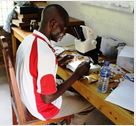 |
| BIZOZA Jean Berchmans, student at the University of Burundi analyzing fruit fly samples |
3. Practical, systematic and ecological study of fruit flies in the city of Bujumbura
The present study was carried out in the city of Bujumbura. It presents the portrait of an agglomeration stuck in its development by the Migwa escarpments, the Congo-Nile ridge to the east, Lake Tanganyika to the west as well as the agricultural plain of Rusizi.
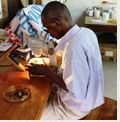 |
This plain is framed by the South parallels 3°08' and 3°23' and the East meridians 29°13' and 29°23. During the study, the method of collection using parapheromone traps installed on fruit trees as well as that of incubation of fruits picked or collected at the foot of the trees were used. Taxonomic analyses required the use of microscopes and determination keys. Quite a few scientists, both national and foreign, have contributed to the completion of this work and the results obtained so far are encouraging. |
| BUKURU J. Berchmans, student at the University of Burundi analyzing fruit fly samples |