
Basic Page
Basic Page
Published on
2020 Jan 13Establishment of the reference situation for monitoring the dynamics of habitats in the Ruvubu National Park
This project is financed as part of the partnership between Belgium and Burundi under the Convention on Biodiversity, through the IMAB program of the Royal Institute of Natural Sciences of Belgium and aims to establish a reference situation for monitoring the dynamics of habitats in 4 sectors of the National Parks of Kibira, Rusizi and Ruvubu. The activities of this project are supervised by Mr. Nzigidahera Benoît (Biodiversity Research Manager at INECN) and Ms. Professor Habonimana Bernadette (University of Burundi, Faculty of Agronomy and Bio-Engineering (FABI), Department of Environmental Management and Ecology (FABI), Department of Environmental Management and Ecology and are carried out in close collaboration with park managers, sector managers, forest rangers as well as four student researchers from University of Burundi
in eastern Burundi with an area of 50,800 ha. The vegetation of the park includes wooded savannas with Parinari curatellifolia (about 7620 ha), shrubby and tree-like savannas with Parinari curatellifolia, Pericopsis angolensis and Hymenocardia acida (38175 ha), grassy savannas with 4072 ha. There are also forest galleries whose area is estimated at 1018 ha. There are also swamps with Cyperus papyrus and other Cyperaceae which occupy about 3299 ha. The specific objective pursued was to define and characterize the vegetation throughout the transect established in the present research.
1. Case of the Right Bank II
The present study took place in Right Bank II of Ruvubu National Park. It is located in the province of Ruyigi. Throughout a transect drawn up during the study, 7 work sites were defined according to habitat types.
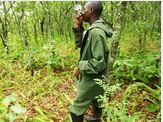 |
Each site was subdivided into equal dials with a side of 10 m. Each dial is in turn subdivided into 100 tiles of the same dimensions, i.e. 1mx1m. The surveys were carried out systematically tile by tile and stratum by stratum beginning with the stratum. The results of this research will contribute to the establishment of reference data for monitoring the dynamics of the habitats of this park. | 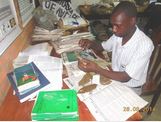 |
| NSHIMIRIMANA Révérien, Student from the University of Burundi during the taking of dendrometric measurements |
NSHIMIRIMANA Révérien, Student from the University of Burundi during the identification of samples |
2. Case of the Left Bank I
The present research was carried out in the Left Bank I of the Ruvubu National Park. in sites selected on the established ecological trail.
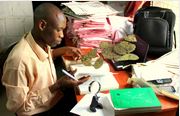 |
Each site has been subdivided into 1 m by 1 m dials. Then, all species in the delineated area were collected dial by dial and stratum by stratum beginning with the upper stratum. The taxonomic determination was carried out in the laboratory and documents containing taxonomic keys were used. |
| NDIKUBWAYO Ernest, Student at the University of Burundi during the identification of samples |
3. Case of the Left Bank II
This work was carried out in the Left Bank II (RG II) of the Ruvubu National Park. The specific objective pursued was to define and characterize the vegetation throughout the transect established in the present research. The work consisted in inventorying and collecting the various plant species along the established ecological trail. A permanent transect extending over 2.13 km has been drawn so as to cross the different types of habitats and perpendicular to the banks of the Ruvubu River. Data collection was carried out in sites of variable area selected on the transect according to the homogeneity of the vegetation and the collection of all plant species present in the study sites was carried out. To conduct this harvest in a systematic manner, each site was subdivided into 1 m by 1 m dials and all species were collected dial by dial and stratum by stratum.
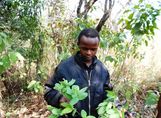 |
Each species collected was assigned an abundance dominance coefficient according to the Braun-Blanquet method. The taxonomic determination was carried out in the laboratory and documents containing taxonomic keys were used. At the end of this work, quite a few plant species have been identified and the study will make it possible to establish a reference situation in order to monitor the dynamics of the habitats of this park. | 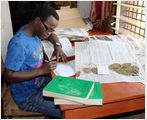 |
| MBARUSHIMANA Didier, student at the University of Burundi, during the collection of samples in the field |
MBARUSHIMANA Didier, Student at the University of Burundi during the taxonomic determination of samples |