
Basic Page
Basic Page
Published on
2020 Jan 14Valorization of Eremospatha haullevileana by cultivation under palm oil
Several million households around the world rely heavily on forest products for their livelihood and/or income. Rattan is one of the main non-wood forest products found in most tropical forests. It is used in crafts and provides valuable goods that are tamed both nationally and internationally.
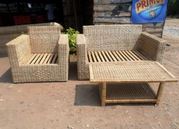 |
In Burundi, Eremospatha haullevileana is the only species of rattan that existed and that had been exploited for a long time in natural environments. Despite the importance of this species, which is so crucial for its multiple uses, few scientific studies have so far been done to better understand this species. | 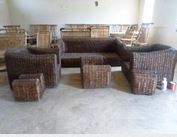 |
It is in this context that this study: “Valorization of Eremospatha haullevileana by cultivation under palm trees in oil” was conducted by Mr. GISAMBA Augustin from the Faculty of Agronomy and Bio-Engineering, University of Burundi (UB), under the supervision of Professor HABONIMANA Bernadette (UB) and Msc. NZIGIDAHERA Benoît from the Burundian Office for Environmental Protection (OBPE).
The overall objective of this study is to test the cultivation of Eremospatha haullevileana to ensure the regular supply of rattan to craft businesses in order to reduce the use of wood and contribute to the conservation of forest resources.
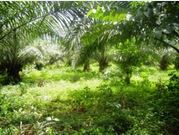 |
The test was carried out in the Kigwena zone in Rumonge commune in two crop fields under oil palm trees of different ages. The first field was located near the Kamango River with the 7-year-old palm trees and the second near the Gitotwe River with the 20-year-old palm trees. Their areas were 36.54 ares and 43.26 ares respectively. | 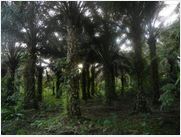 |
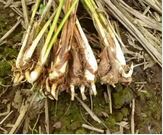 |
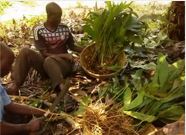
The suckers were planted manually at the rate of one sucker per hole over a distance of 7m by 3m. This study took place over a period of 238 days (from June 13, 2016 to January 23, 2017) and involved 454 plants, i.e. 210 under 7-year-old oil palms and 244 under 20-year-old oil palm trees. Parameters such as recovery rate, survival rate, and height were studied. | 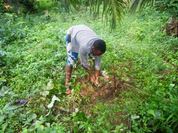 |
 |
The student also conducted a socio-economic survey among rattan operators represented by collectors and artisans (rattan processors). This survey was conducted among 46 collectors in the Kigwena zone in Rumonge commune and four artisan societies in Bujumbura City Hall. The data collected were recorded on survey sheets specifically designed for each socio-professional category. This investigation lasted one month. | 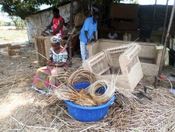 |