
Basic Page
Basic Page
Published on
2020 Jan 16Contribution to the study of the interrelationships between pollinators in the Rumonge Forest Nature Reserve and those in coastal agricultural environments
The present study was carried out in the Rumonge Forest Nature Reserve, which consists of open forests mainly dominated by the light forest type miombo. This reserve covers an area of 600 ha.
The present study was carried out by:
NDA YIKEZA Longin
Under the supervision of:
- Mr. Benoît NZIGIDAHERA, Biodiversity Research Manager at the National Institute for Environment and Nature Conservation (INECN)
- Prof. Bernadette HABONIMANA, Professor at the University of Burundi, Faculty of Agronomy and Bio-Engineering (FABI), Department of Environmental Management and Ecology.
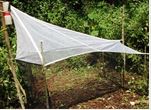 |
At the time of capturing the insect samples, four methods were adopted. These are: the entomological net method; - the Malaise trap method; - the soapy water trap method; - the manual capture method. |
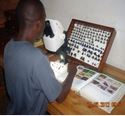 |
Regarding taxonomic identification, the first identification step was the separation of specimens according to their morphological resemblance by “morphospecies”. A microscope and books containing determination keys were used to separate the specimens into different taxonomic groups. To exploit the results obtained, several analysis methods are used such as total wealth, relative abundance, the Margalef diversity index and the Sørensen similarity index. This study provided important information on the pollinating species of the Rumonge Forest Nature Reserve and its coastal agricultural environments, the phenology of these species and the role of this clear forest in their protection.
Publications published:
1. Abundance and distribution of bees of the genus Xylocopa Latreille, 1802 (Hymenoptera: Apoidea) from Burundi
2. Bees of the genus Meliponula Cockerell, 1934 (Hymenoptera: Apoidea), potentiality for meliponiculture in Burundi
3. Dominance of Apis mellifera L. (Hymenoptera, Apoïdea) in natural ecosystems and agro-ecosystems in Burundi: risk of erosion of wild bee fauna