
Basic Page
Basic Page
Published on
2020 Jan 21Training on the taxonomy and ecology of pollinating insects in the National Parks of Rusizi, Kibira and the Murehe Nature Reserve and their coastal agricultural environments at the Royal Institute of Natural Sciences of Belgium on November 16
 |

|
 |
a training course at the Royal Belgian Institute of Natural Sciences (IRSCnb). The training focused on techniques for the taxonomic identification of pollinating insects. This scholarship was awarded as part of the Global Taxonomy Initiative (GTI) of the same institution.
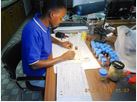 |
During this internship, professional techniques for preparing, handling, labelling, and maintaining specimens were learned. During preparation, only large specimens are pinned with the small pin (no. 1). The other specimens are stuck on plates intended for this purpose to prevent them from being destroyed by the pin. |
Gum arabic was used in the preparation of these specimens because it sticks well to the plate and to the integument of the animal and is soluble in water, which makes it possible to take off the animal if necessary, for example if one wants to do molecular analyses. The animal must be prepared so that as many parts of its body as possible are visible, which makes taxonomic analysis easy, as a poorly prepared animal is not suitable for identification. The animals should not be put directly into the entomological boxes but should remain spread out on plates to be completely dry.
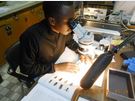 |
Also, the internship concerned microscopic analyses and the determination keys contained in “The genera and subgenera of bees in sub-Saharan Africa (2010)” were used. To make comparisons with typical species, we had access to insect collections from this same institution. These supports made it possible to determine the different species of Halictidae from Burundi and some species from other families and genera. | 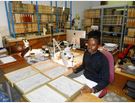 |
The training also made it possible to learn how to preserve and carefully treat collections in entomological boxes. The results of our work on pollinators revealed that there is an interrelationship between pollinators in natural environments and those in agricultural environments. This interrelationship is beneficial for pollinators and both environments because the diversity of pollinators allows a diversity of plants and conversely the diversity of plants allows a diversity of food for pollinators.