
Basic Page
Basic Page
Published on
2020 Jan 24Course of the course on the analysis of the specific richness of certain families of flora in protected areas in Burundi
From February 13 to March 13, 2018, three students from the University of Burundi, Faculty of Sciences, Department of Biology in 3rd year Baccalaureate completed a training course at the Biodiversity Research Service of the Burundian Office for Environmental Protection (OBPE) under the supervision of Dr. NDAYISHIMIYE Joël from the University of Burundi and Mr. NDUWARUGIRA Oscar from the OBPE. The objective of this work was to analyze the specific richness of plants in ecosystems in Burundi. The specific objective of this course was to organize specimens from the Rubiaceae family into genera and species found in the herbarium stored at the OBPE herbarium.
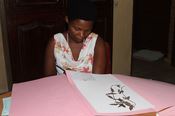 |
This is how the student NIYAKIRE Aline worked on the analysis of the specific richness of plants from the Rubiaceae family of ecosystems in Burundi. The student NDIKURIYO Jean Claude worked on the analysis of the specific richness of plants from the Fabaceae family distributed in the various ecosystems of Burundi. | 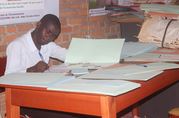 |
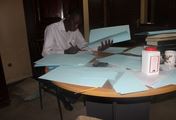 |
Finally the student, NDIKUMWENAYO Astère worked on the analysis of the specific richness of plants from the Asteraceae family of ecosystems in Burundi. |
The activities of this internship began with a contact session with OBPE supervisors marked by a brief exchange on the subjects covered by the internships as well as on the course of the internship. After this session, the trainees sorted the specimens of Fabaceae, Asteraceae and Rubiaceae found in the cabinets where the herbariums are kept. Each herbarium included the following information: the location where the sample was collected, the date of collection, the date of collection, the description of the sample, the description of the sample, the geographic coordinates, the name of the person who first named and described the species, the name of the person who first named and described the species, the name of those who identified it, the name of the herbarium, the name of the species in the first place, the name of those who identified it, the name of the herbarium, the name of the person who first named and described the species, the name of the person who first named and described the species, the name of those who identified it, the name of those who identified it, the name of the herbarium, the name of the person who first named and described the species, the name of those who identified it, the name of the herbarium, the name of the species, habitat and altitude. All of this information was recorded in a log book. Finally, the intern students arranged genera and species that are similar according to localities and habitats in order to analyze their specific richness. The determination of the herbariums was made thanks to the works of Troupin.