
Basic Page
Basic Page
Published on
2020 Jan 24Study of the biodiversity of reptiles preserved in the OBPE laboratory: the case of chameleons and agamas
From February 13 to March 13, 2018, the student NIYONKURU Obède from the University of Burundi, Faculty of Sciences, Department of Biology in 3rd year Baccalaureate completed a training internship at the Biodiversity Research Service of the Burundian Office for Environmental Protection (OBPE) under the supervision of Professor NTAKIMAZI Gaspard from the University of Burundi and Mr. MASABO Onesphore from the OBPE.
The general objective of this course was to improve knowledge on the diversity of reptiles: the case of Chameleons and Agamas
Specific objectives of the internships
- Know the techniques for collecting samples in the field
- Know the techniques for preserving specimens;
- Learn how to set up zoological collections for the purposes of in-depth scientific research;
- Apply the theory learned at school during the university course on the living world around us;
- Immerse yourself in the management of zoological collections;
- Know the distribution of different chameleon species in the territory of Burundi in particular;
- Know their life mechanisms according to the environment.
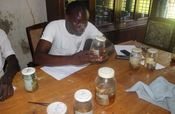 |
This internship focused on samples captured manually by OBPE researchers and they are preserved in alcohol at the OBPE biodiversity research laboratory. First, the student sorted the reptile specimens, more particularly agamids and chameleons, among the other reptile samples preserved in the OBPE laboratory. Then, the student counted the specimens using tweezers. Afterwards, the student grouped the specimens into families using keys to identify reptiles, more particularly chameleons and agamas, found in the library of the OBPE biodiversity research service. |
All specimens grouped into families were recorded in a register with full details including the name of the species, the number of individuals in the box, the date of collection, the name of the family, the place of collection, the place of collection, the name of the collector, and the name of the species determinator.