
News
News
Published on
2020 Feb 25Fish farming on Lake Victoria: a lesson for Burundi on Tanganyika?
If Lake Victoria now represents more than $1 billion in annual exchanges, it is also thanks to innovative projects such as intensive fish farming within projects supported by the Lake Victoria Fisheries Organization (LVFO), one of the EAC institutions. Something to inspire Burundi.
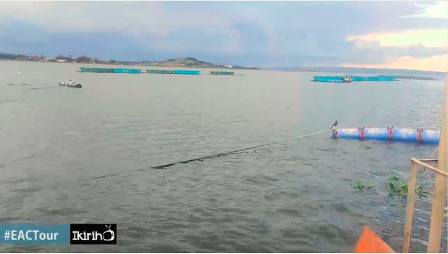
Imagine fifty cages 6m long, 6m wide and 7m deep. Placed on the lake while floating thanks to plastic barrels, they each contain 17,000 tilapias. Before arriving in these cages, these fish were weighed to correspond to the quantity of food to be put in a cage, i.e. 150 kg of cake per day. “After 6 months of maturation, each cage will have produced 8 tons of fish,” explains Ir. John Bolingo, head fish farmer of “Source of the Nile”, a fish farming project funded by the LVFO in Jinja.
“Once you've set up the cages, the rest is easy to manage. Fish evolve in their natural environment, there is no need to change the water, and consumers prefer this kind of fish rather than canned ones because the taste is not the same.” The market for this very profitable business is mainly Kenya, in the cities of Nakuru, Eldoret and Nairobi: “We send 10 tons there per week”, explains Ir. Bolingo. Other cities in Uganda, and Rwanda, swallow up between 2 and 4 tons of fish cargoes leaving Jinja every week.
Let's imagine for a moment a company like this in Burundi. Having half the area of Lake Victoria, Tanganyika with its 32,900 km² is 10 times deeper, its average depth being 570 m, against 40 for Victoria. Knowing that the average cost of installing a cage is around $1,500, and that it has an average life of 20 years, it is not rocket science to imagine what advantages such a business would generate for the country. Whether on Lake Tanganyika, or in the lakes in the north of the country.
Moreover, Dr. Anthony Taabu-Munyaho of the National Fisheries Resources Research Institute (NAfirri) recalls that Burundi is the country whose citizens eat the fewest fish in the EAC, although it has an extraordinary hydrological network.
In his presentation of the LVFO, its executive secretary Godfrey Vincent Monor recalled that this specialized EAC institution created in 1996 allowed the establishment of “quality assurance mechanisms in the export of EAC fish, giving them access to markets in more than 24 countries over the last 16 years, including Europe. This translated into an increase in exports from $51 million in 1994 to over $350 million in 2018.”
Thanks to German cooperation (GIZ), the LVFO benefits in particular from €8 million for the implementation of the Nile Perch Fisheries Management Plan, a fish that alone generates 250,000 tonnes of meat per year in Lake Victoria. Adolf Gerstl, in charge of this project on the GIZ side, emphasizes that this funding, which runs from 2015 to 2019, aims in particular to increase the production of Nile perch, reduce illegal fishing and support and strengthen the structuring of activities on the lake.
Thus, nearly 30,000 Ugandan fishing boats will be officially registered (or 39% of the boats that operate on Lake Victoria), while 2,000 fishing businesses led by women around the lake will benefit from financial management training.
The Secretary General of the EAC, visiting the LVFO, welcomed its dynamism: “Your activities respond to our first priority in the EAC development strategy, which is the food security of the populations of the region. Every EAC employee should be confident that what they do directly benefits grassroots communities. Thanks to you, fish from Lake Victoria can be sold in Africa, Europe and the world. It is an important step for the regional economy.”
 |