
Basic Page
Basic Page
Published on
2020 Mar 03Report of the training workshop on the establishment of the logical framework for institutional cooperation Cebios-Obpe (2019-2023)
From 11 to 12 April 2018, a workshop was held in the premises of the liaison office of the Burundian Office for Environmental Protection, a workshop to exchange and formulate the logical framework for institutional cooperation between CEBios and the OBPE.
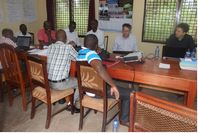 |
Present in this workshop were Mr. Luc Janssens from Bisthoven & Han de Koeijer, respectively Coordinator of the CeBIOS program and the Focal Point of the CHM-Belgium. This workshop also saw the participation of various OBPE officials, professors from higher education institutions in Burundi and representatives of local NGOs working in the field of biodiversity protection. |
| The activities of this workshop were opened with a welcome speech delivered by the Director General of the Burundian Office for Environmental Protection. In his speech, he asked the participants to contribute fruitfully to the establishment of the logical framework for institutional cooperation CeBIOS-Obpe (2019-2023). | 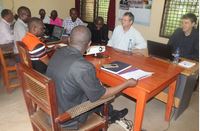 |
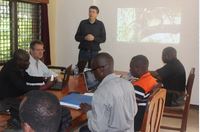 |
After the opening of this workshop, the opportunity was given to Mr. Luc Janssens de Bisthoven, coordinator of the CeBios program, who first recalled that the process of formulating the logical framework of the five-year plan (2014-2018) consisted of a participatory workshop, construction of a problem tree and solutions with strategies and expected results. |
For the formulation of the logical framework for the 2019-2023 program, he added, a workshop was held to present the various achievements of phase I. Recommendations for the formulation of phase II by the stakeholders were identified and exchanges with Belgian actors took place. The interventions resulting from this work will be used in the construction by OBPE and CEBIOS of the new logical framework based on the theory of change in contrast to the problem tree and solutions on the basis of which, the logical framework of phase I was built.
The formulation of the logical framework for cooperation between OBPE and CEBIOS began with a brief introduction to the basic elements of the theory of change which are spheres of control, influence, and interest. Therefore, explained Mr. Luc, the theory of change is based on resources, activities and results to arrive at the impacts or in a global way the impacts related to the activities carried out.
|
Next, the participants analyzed the PESTELI factors (Political, Economic, Social, Technological, Environmental and Institutional) for Burundi. For each category, there were positive factors and negative factors. This is how 2 groups were formed and were mixed from time to time with rotations of the rapporteurs. They analyzed these factors by adapting the factors pre-established by CEBIOS for the case of Burundi. |
 |
To do this, some factors have been reformulated, others disregarded. It should be noted that other factors have been added in the same logic of adapting them to the situation in Burundi.
The activities of this day continued with the risk analysis based on the PESTELI exercise for the cooperation of OBPE with CeBIOS. To do this work, 2 groups were formed. The first group analyzed Political, Economic, Social and Cultural factors and the second, Technological, Environmental, Legal and Institutional Factors.
For each negative factor, a score on the degree of severity and on the probability of achievement was given.
Before completing the activities of the first day, the participants reviewed the risks of the targeted negative factors by analyzing whether the OBPE can make interventions to correct these negative factors. The actions to be taken have been proposed.
The activities of this day were closed with a word of thanks from Mr. Luc Janssens from Bisthoven to the participants for the work done in the process of formulating the new logical framework for cooperation between OBPE and CEBiOS.
2nd day
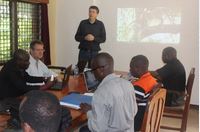
The activities to formulate the new logical framework for cooperation between OBPE and CEBIOS continued with the second basic element in the theory of change, which is the sphere of interest or concern. The coordinator of the CeBIOS program continued to guide the activities of this workshop. For Burundi, the participants indicated that this sphere consists of the populations living near protected areas.
In the theory of change, the first question asked was: “What is their dream in Burundi?” The second question was the following: “What changes should occur among the populations living near protected areas to achieve this dream in Burundi?” The answers to this last question are:
- Better understand the challenges of biodiversity;
- Use sustainable practices in their daily lives;
- More and better transmit and communicate their traditional knowledge.
Another question asked was: “What would be the consequences of realizing this dream in Burundi?” The participants replied that for Burundi, it is:
- the strategic framework for the fight against poverty;
- the contribution to the implementation of national policies (socio-cultural, economic, environmental);
- strategic plans, etc.
 |
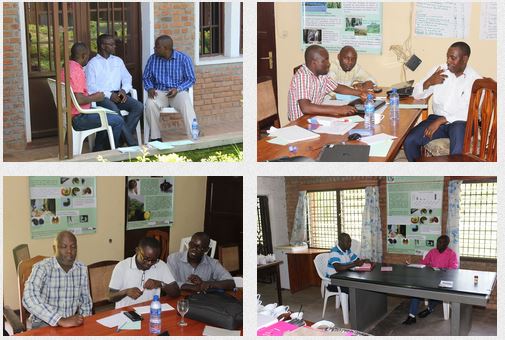
The other sphere analyzed was that of influence, i.e. OBPE partners in biodiversity protection activities. For this sphere of influence, the CeBIOS Program Coordinator asked each participant to write an OBPE partner in the field of biodiversity protection on a card. In the end, almost all partners have been listed. These partners are Scientists, Ministries, other political actors and private partners. |
Afterwards, the participants listed on the maps the changes they wanted for each category of OBPE partners. Four groups were formed and each group worked on a targeted partner category.
|
According to the objectives formulated, the participants linked these objectives to the Intermediate Results found in the logical framework of the OBPE (IR1, IR2, IR3 and IR4). Indicators were given and typical activities proposed.
The control sphere was analyzed last. The participants listed the target groups at OBPE in the management of protected areas.
On maps, the participants then listed the changes required in the various OBPE target groups to better carry out its missions. Basic indicators have also been given.
The activities of these two days were closed with two words of thanks from Mr. Luc Janssens from Bisthoven who warmly thanked the participants for the work they had just done in formulating the logical framework for cooperation between OBPE and CEBiOS. Finally, Mr. MASABO Onesphore took the floor and sent his sincere thanks to the CBD, the Royal Institute of Natural Sciences of Belgium in general and CEBiOS in particular for their technical and financial support to support Burundi in this noble task of conserving and promoting biodiversity.