
Basic Page
Basic Page
Published on
2020 Apr 23National workshop to validate the National Strategy and Action Plan on access to genetic resources and the sharing of benefits arising from their use in Burundi
This workshop was organized as part of the project “Ratification and implementation of the Nagoya Protocol on access to genetic resources and the fair and equitable sharing of benefits arising from their use in COMIFAC space countries” project under the funding of UNEP.
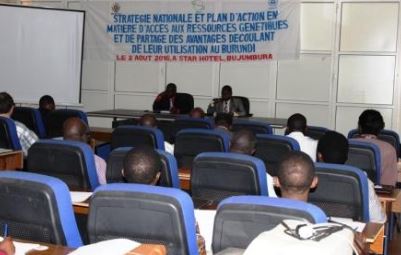
This workshop was opened by a speech by the Assistant to the Minister of Water, Environment, Land Use Planning and Urbanism. This speech consisted first of all in an expression of welcome to the participants who responded to the invitation, then in a reminder of the date of accession of Burundi to the Nagoya Protocol and its objective on Access to Genetic Resources and the Fair and Equitable Sharing of the Benefits arising from them.
 |
The speaker did not fail to mention the initiatives already undertaken for its implementation, which are consultations and consultations with all stakeholders, a strategic framework for improving the level of understanding on the challenges of the Nagoya Protocol and awareness-raising guides, training by a UNEP expert on access and benefit-sharing related to genetic resources in order to strengthen national capacities in this area.
The opening was followed by the presentation of the National Strategy and Action Plan document on access to genetic resources and the sharing of benefits arising from their use in Burundi by the APA Focal Point, Msc. NZIGIDAHERA Benoît.
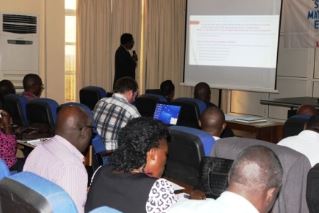 |
During the presentation, the speaker began to recall the three objectives of the Convention on Biological Diversity, namely: the conservation of biodiversity, its sustainable use as well as the fair and equitable sharing of the benefits arising from it. He then spoke about the objective of the Nagoya Protocol, which is to ensure that those who access genetic resources share the monetary and non-monetary benefits they derive from the use of such resources with countries of origin and local communities in these countries. |
Then, he spoke about the status of implementation of the Nagoya Protocol as well as existing capacities for access and sharing by showing the needs for establishing procedures as well as research capacities on genetic resources. He did not fail to mention human resources, infrastructure, equipment, and operationality. He also highlighted the capacity to communicate and exchange information on ABS as well as the capacity to mobilize financial resources. He also talked about strengths and weaknesses, opportunities, threats in the face of applying APA procedures.
Before completing the presentation, the presenter listed the constraints of implementing the process which are the elements of the strategy, the commitments of Burundi, the national vision, the guiding principles, the strategic accesses, the objectives of the strategy, the objectives of the strategy as well as the action plans. In addition, he set out the modalities for implementing the APA process, which are the coordination of the strategy, the financing mechanisms, the monitoring and evaluation of the strategy as well as the establishment of tools, means and capacities.
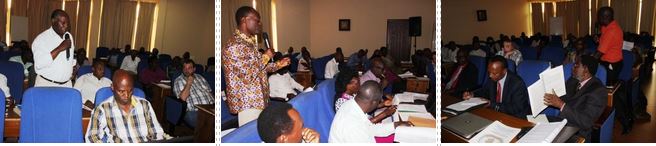
After the presentation, participants had a moment of exchange during which the following concerns were highlighted:
- - The existence of an inventory of genetic resources and their geographical locations, since most of them are endangered;
The fact of highlighting animal genetic resources because there is a treaty, ordinances and even a global plan of action that talks about these resources; - The need for harmonization of legislation within a regional framework for the management of genetic resources in order to incorporate common visions;
- The existence of informal collaboration between the University of Burundi and other research institutions;
- Lack of collaboration between ministries involved in the management of genetic resources.
|
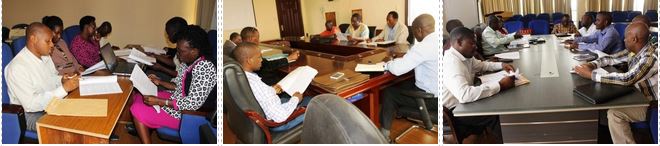
The moment of the exchanges was followed by work in committees where the participants formed three groups. The results of the work in committee were presented at the plenary session.
|
At the end of this workshop, the following recommendations were formulated:
- Establish a framework for coordinating research in the field of genetic resources to avoid the dispersion of data resulting from inventories;
- Highlight the content of treaties, ordinances and global plans of action on animal genetic resources;
- Negotiate the harmonization of regional legislation on the management of genetic resources in order to avoid biopiracy;
- Strengthen collaboration with ministries whose actions contribute to the degradation of genetic resources by integrating actions to protect these resources into their sectoral policies;
- Create a fund to stimulate holders of genetic resources to provide information on traditional knowledge;
- Have the document prefaced by a competent authority.
After observations and considerations relating to it, the document of the National Strategy and Action Plan on ABS was validated with the integration of certain amendments. The workshop ended at 16:40 p.m., Bujumbura time.