
Basic Page
Basic Page
Published on
2020 Apr 24National workshop to validate the draft decree on Access to genetic resources and the fair and equitable sharing of benefits arising therefrom and the model ABS agreements
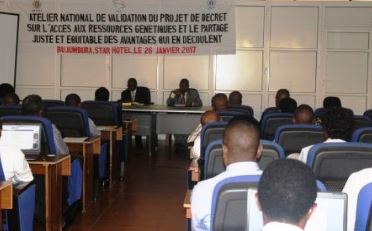
On 26 January 2017, a national workshop was held at the Star Hotel to validate the draft decree on Access to Genetic Resources and Fair and Equitable Sharing of Benefits arising from them as well as the model ABS agreements to implement the Nagoya Protocol to implement the Nagoya Protocol, within the framework of “Ratification and implementation of the Nagoya Protocol on Access to Genetic Resources and the Fair and Equitable Sharing of Benefits Arising from their Use in the countries in the COMICAF space” under funding from UNEP.
The workshop was opened by a speech delivered by the Assistant Minister in charge of the Environment who first recalled that Burundi adhered to the Nagoya Protocol in October 2010 on Access to Genetic Resources and the Fair and Equitable Sharing of Benefits arising from them. He thus showed the objective of the workshop, which is to provide Burundi with an instrument that will serve to fill the legal void in this area promoting the fraudulent use of Genetic Resources (GR) and Associated Traditional Knowledge (CTA) without the country of origin benefiting from them, which leads to the loss of these biological resources.
|
In order to regulate access to these resources, he added, the draft decree that will be validated is supplemented by model agreements to facilitate its application. The Assistant Minister in charge of the Environment ended his speech by thanking the participants for having responded to the invitation, thus showing their willingness to contribute to the implementation of the Nagoya Protocol.
After the opening of the workshop, participants followed two presentations: the first on the draft decree on Access to Genetic Resources and the Fair and Equitable Sharing of Benefits arising from them and the other on model ABS agreements to facilitate Access to Genetic Resources.
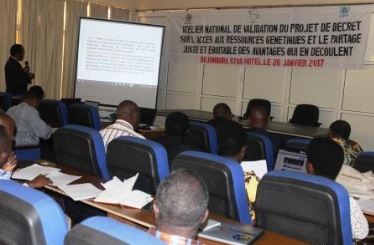 |
During the first presentation made by the lawyer, Mr. NINDORERA Damien, the participants successively followed the context of the establishment of a draft decree on ABS; the structure and content of the draft decree; the various definitions used in ABS; the general principles for the management of ABS; the general principles for the management of ABS; the typology of genetic resources and associated traditional knowledge; the institutional framework for managing access to genetic resources and sharing the resulting benefits; the provisions on ABS and surveillance and finally the various and final provisions. |
| Indeed, he concluded, the user will access and use the RG and/or CTA only according to the terms declared in the request form; any access and use of the RG and/or CTA that is not expressly mentioned in the request form should be considered prohibited. | 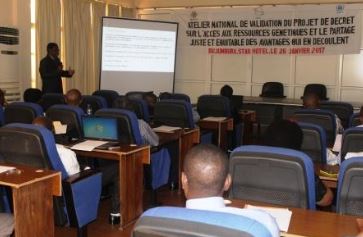 |
Access to and use of microorganisms derived incidentally from genetic resources are expressly prohibited. The user agrees not to use genetic resources and/or associated traditional knowledge other than for the uses specified in the application form.
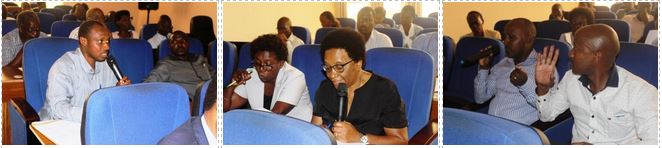
After the series of presentations, participants commented, expressed opinions and considerations, expressed concerns about the content of the presentations and the formulation of recommendations.
|
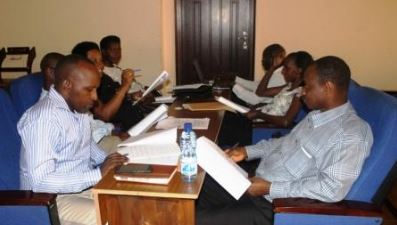 |
The participants then formed working groups to thoroughly analyze the content of two documents before they were validated. The report on the work of the committee took place in plenary session where each group gave its contribution relating to the substance and form of the documents presented. | 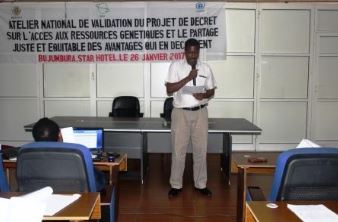 |
At the end of this workshop, the recommendations made are as follows:
- In terms of visas, we must add the law on fisheries and aquaculture in Burundi, which has just been promulgated;
- Decentralize the APA National Committee by including nationals from all sectors concerned by APA;
- Initiate a survey on the state of play to find out the country's wealth in genetic resources;
- Strengthen the capacity of staff to be able to negotiate the benefits that flow from genetic resources;
- Develop a communication strategy that will serve to approach all ABS stakeholders;
- Traditional knowledge associated with genetic resources must be properly identified and protected for negotiation purposes;
- Set up a permit management mechanism (initiate computerized management);
- Include in the draft decree an article on the strict management of permits for access to genetic resources and associated traditional knowledge;
- Recognize that even communities that do not own genetic resources should benefit from the benefits that derive from their exploitation, such as conservation;
- No Burundian may be a commissionaire of a firm in the negotiation process on the use of genetic resources;
- Appoint an ad hoc committee to determine the monetary and non-monetary benefits associated with access to genetic resources and associated traditional knowledge.
In conclusion, the draft decree on Access to Genetic Resources and Fair and Equitable Sharing of Benefits from Genetic Resources and the model ABS agreements to implement the Nagoya Protocol have been validated with some amendments made to it.