
Basic Page
Basic Page
Published on
2020 Apr 27National workshop to validate the Interim National Report on the Nagoya Protocol
On October 31, 2017, the Burundian Office for Environmental Protection (OBPE) organized, within the premises of the Hotel la Palmeraie, a national workshop to validate the Interim National Report to the Nagoya Protocol for all stakeholders in the implementation of the Protocol since its signature in 2014 by Burundi.
|
|
The activities of this workshop began with a speech by the representative of the Ministry of Water, Environment, Land Management and Urban Development (MEEATU) In his speech, he spoke about the various achievements of Burundi in the implementation of the Nagoya Protocol, materializing in the establishment of ABS strategies and action plans as well as the development of a law (draft decree) on ABS. |
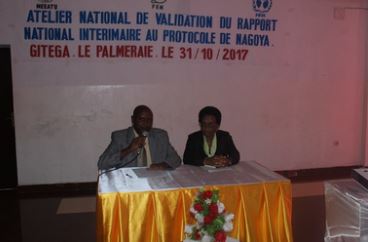
He continued his speech by telling the participants the objective of the workshop, which is to validate the interim national report on ABS to be submitted to the secretariat of the Convention on Biological Diversity. He noted that this report has been reviewed and pre-validated by technicians who closely monitor the implementation of the Nagoya Protocol in Burundi and that participants are called upon to enrich and validate this report. He closed his speech by thanking the participants for their presence and wishing them good work.
| This speech was followed by a first presentation by Mr. Benoît Nzigidahera, APA National Focal Point on the various achievements for the implementation of the Nagoya Protocol on Access and Sharing of Benefits arising from the use of genetic resources (ABS) in Burundi. | 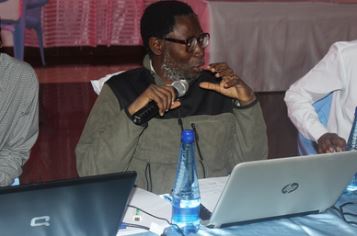 |
During this presentation, he specified the actions already taken in the area of ABS, namely: the appointment of competent ABS authorities: the Focal Point of the CHM-Burundian, the competent national authority on the ABS-CH site to provide information on ABS as well as the national authority competent for the Nagoya Protocol; the establishment of policies and strategies: National ABS Policy, national ABS strategies and the development of laws: draft decree on ABS not yet promulgated.
To operationalize APA in Burundi, he added, other activities were carried out, namely the establishment of the strategic plan for research on medicinal resources: a memorandum of understanding was concluded between traditional practitioners and researchers. This memorandum is currently in the hands of the Ministry of Public Health and the Fight against AIDS, the training of several managers (including members of the APA National Committee) by an expert from UNEP (United Nations Environment Programme) as well as awareness-raising activities for the various target groups.
Continuing his presentation, he mentioned that despite these various achievements, Burundi has another duty to write the interim national report to inquire about the situation of the implementation of the Nagoya Protocol in all countries in order to prepare for COP2020. This report will assist in the formulation of recommendations for projects to be implemented.
Concluding his presentation, Msc. Benoît Nzigidahera, said that this report was written by executives selected at the OBPE level and that it has already been submitted to the CNAPA reinforced by APA technicians for the correction and enrichment of this report. He then let the participants know that this document has been pre-validated and that they are called upon to analyze and approve it for its online and hard copy submission on November 2, 2017.
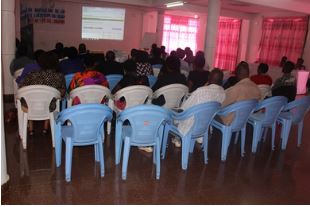 |
The second presentation was made by the competent national authority on the ABS-CH site Mr. MASABO Onesphore. During this presentation, he said that ABS-CH (Access and Benefit-Sharing Clearing-House) is the ABS Information Exchange Center where each country has its gateway where it posts its information. Since we work on genetic resources, this site allows other countries in the world that want to exploit the genetic resources of Burundi to know the laws that govern them in order to comply with them. Continuing his presentation, he presented the files and the various information posted, those already validated or awaiting validation. |
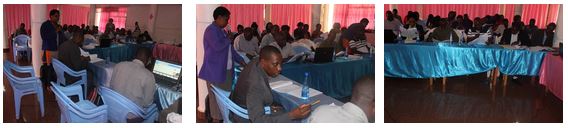
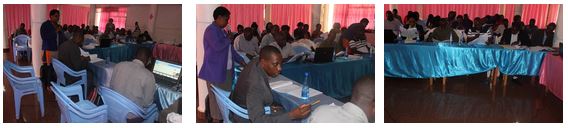
After these presentations, Mr. legal expert Damien NINDORERA presented the report to the participants asking them to divide themselves into three groups according to the one-two-three counting system. To each group, he gave the questions to be analyzed and told them that this work would last 2 hours including the presentation of the results. The participants then started to analyze the report in their respective groups.
|
The group work was concluded by the presentation of the results of their analysis. Each group, through its representative, was able to give their comments and corrections to the report.
|
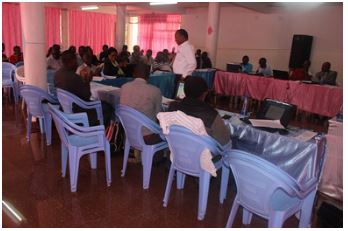
This session to summarize the results was followed by the validation of the interim national report by acclamation.
|