News
News
Published on
2020 Oct 06Disarray of some Burundians following climate change
The consequences of climate change continue to worsen in a significant part of the country. To prevent them, compliance with laws, the implementation of disaster risk mapping, and the involvement of everyone in the protection of the environment are a necessity.
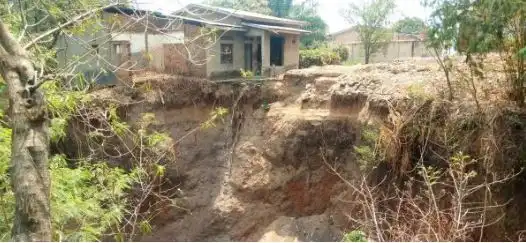
Radio Isanganiro, Rema FM and Izere FM as well as the Iwacu press group, the newspaper Burundi Eco and the bloggers' collective Yaga, under the financial support of Benevolincia, organized this Thursday, September 10, 2020, a media synergy on the effects of climate change in Burundi. In the capital of Muyinga province, it was specified that the inhabitants of the Kinyota district are living with fear in their stomachs following the ravine which is constantly growing due to floods and heavy rains. According to Ms. Nadia Habonimana, some waterfront infrastructures have already collapsed while others are on the verge of collapse. The water tap at this location was damaged by runoff. In addition, we were told that a child has also left us due to the rainwater that passes through this ravine. According to Ibrahim Niragira, the tracing of anti-erosive hedges is a necessity to combat erosion, which contributes to the creation of ravines.
In Bujumbura, the rise in the waters of Lake Tanganyika is also a problem for residents. They are sounding the alarm that their infrastructures are overwhelmed. Some huts located on beaches such as Petit Bassam, Karera Beach, Borabora, Saga beach, etc. were flooded. And to add the phenomenon of ravination that is wreaking havoc in some neighborhoods in the municipality of Bujumbura. The most emblematic example is the ravine that separates the districts of Kamesa and Kinanaira II in the Musaga zone. Residents are worried about it. They are in the oven and in the mill. In Rumonge, neighborhoods like Kanyenkoko are flooded. We are in the process of rehabilitating infrastructure damaged by rainwater. The estimated three power poles fell into the waters of Lake Tanganyika.
The effects of climate change are huge
According to Anicet Nibaruta, Deputy Director of Civil Protection and Executive Secretary of the National Platform for Disaster Prevention and Management, the consequences of climate change are enormous. Every year, human and material losses are recorded. Injured and displaced people as well. In 2014, 78 cases of death were registered following floods in Gatunguru in Ntahangwa commune. 20,000 people were displaced. Roads and bridges have been damaged.
Towards the end of the first half of the year 2020, the population of the Gatumba zone was also a victim of floods linked to the overflow of water from the Rusizi River associated with the rise in the waters of Lake Tanganyika. The victims were at full throttle relocated. They were installed in 4 sites. The first site is Maramvya Sobel where 572 households with a population of 2850 people were installed, including 1309 male and 1581 female. The 2nd is Kinyinya II which has 2525 households with a population of 13,635 people including 6,409 male and 7226 female. The 3rd is Kigaramango where 1314 households have been established with a population of 6766 people including 2921 male and 3845 female. The 4th is Maramvya Kirwati-Mafubo where only 133 households have been established with a population of 746 people including 362 men and 384 women. In total, there were 4544 households with a population of 24,034 people, including 11,001 male and 13,036 female, who were victims of the Gatumba floods. In addition, Nibaruta cites the victims of the floods that occurred in the Uwinterekwa district, estimated at 101 households. In the same place, 15 cases of death were recorded. The Mubone site is home to more than 740 households affected by the floods in Buterere and Kinama.
In Cibitoke, and more particularly in the town of Mugwi, more than 20 people lost their lives. More than 250 households have no place to stay. According to Nibaruta, all these statistics really show that Burundi is facing the effects of climate change.
Some victims accused of being at the origin of their misfortunes
Omer Niyonkuru of the Burundian Office of Urbanism and Housing (OBUHA) says that the damage associated with natural disasters is enormous in Burundi. Nevertheless, it indicates that the victims have a share of responsibility for the misfortunes that befall them. You build jumble and everywhere. Even in swamps or ravines. According to Niyonkuru, the OBUHA is not omnipresent to discourage anyone intending to build anarchically. He therefore asks local authorities to give their contribution to reverse the trend. He notes that a toll-free number will be set up to alert in such cases.
According to Jean Marie Sabushimike, a professor at the University of Burundi, the damage is not only linked to climate change. There are other factors as well. The population does not know what climate change is and its effects. Even if local officials are accused of not contributing to the fight against lawless buildings, Sabushimike refutes this by arguing that they are not in a position to realize if this will lead to serious consequences after a while. In addition, there is a problem of land use planning, non-compliance with texts such as water and urban planning codes. And to add the poverty of households associated with the galloping demographics, which means that we allow ourselves to build anywhere and in any way. Another challenge is that there is no legislation on disaster management and prevention. In addition, a disaster risk map has not been put in place to identify areas at very high risk.
To reverse the trend, Nibaruta is calling for strict compliance with laws and the suspension of the uncontrolled extraction of building materials in rivers.
It should be noted that the budget for disaster risk prevention in the year 2020-2021 is estimated at 100 million FBu.