Document
Document
File Name
projet-programme-travail-ap-bi.pdfFile Type
PDF DocumentFile Size
255 kBCreated Date
2020 Dec 21Updated Date
2020 Dec 21Published on
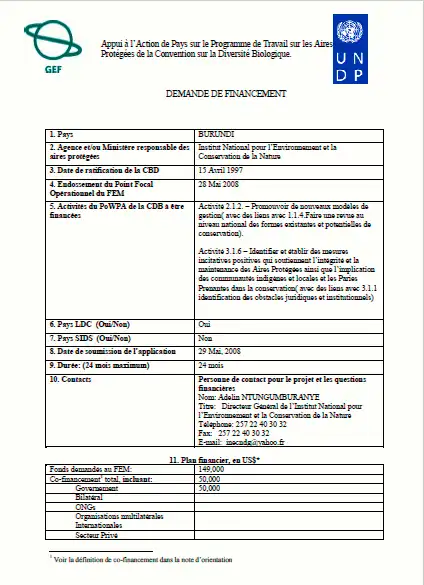
2008 Apr 15Support for Country Action on the Work Programme on Protected Areas of the Convention on Biological Diversity.
Burundi is the country in Central Africa which has a highly varied environment. It covers an area of 27,834 km² including 25,200 km² on land. It is an essentially agricultural country, with an average density of 230 inhabitants per km². The Burundian economy is largely based on the primary sector, which occupies nearly 90% of a population estimated at around 7,000 inhabitants.
The whole of this relief forms a complex of 5 ecological zones at the origin of diversified ecosystems. The vascular flora of Burundi is estimated at 2909 species. Non-vascular flora includes algal flora, whose inventory lists 1514 species, mushrooms including 106 known species. The fauna of Burundi is represented by 1202 vertebrates that are relatively well known and invertebrates that are very poorly studied.
All this biodiversity is mainly preserved in protected areas. Burundi has 14 of them divided into 4 IUCN categories: 2 National Parks, 6 Nature Reserves, 2 Natural Monuments and 5 Protected Landscapes. Overall, these areas have an area of approximately 127,662.85 ha, or 4.6% of the country's total.
Burundi is an active participant in the processes of the Convention on Biological Diversity and is committed to implementing the Programme of Work on Protected Areas of the Convention on Biological Diversity. Protected areas cover almost every ecosystem. However, some of them are still poorly represented in the system of Protected Areas: marshes, rivers and lakes, open forests. The latter, however, are well known and documented and therefore (as is clear from the initial POWPA analysis) no evaluation gap is necessary for Burundi (i.e. Activity 1.1.5 is less suitable than some others).