Document
Document
File Name
synthese-rapport-planete-vivante-2020_wwf.pdfFile Type
PDF DocumentFile Size
7.96 MBCreated Date
2021 Jun 29Updated Date
2021 Jun 29Published on
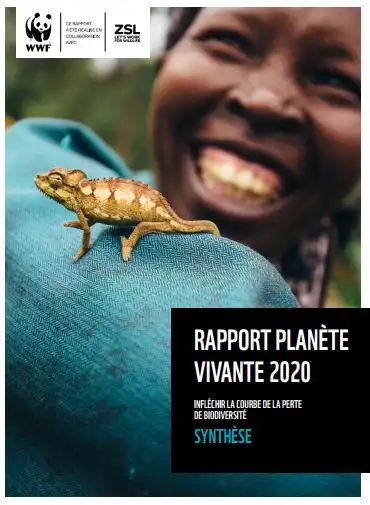
2020 Sep 10Living Planet Report 2020: Bending the Biodiversity Loss Curve
Over the past fifty years, the explosion of global trade and consumption, together with the rapid growth of the human population and a gigantic urbanization movement, have transformed our world. These developments have led to an unprecedented degradation of nature and the overexploitation of natural resources. A handful of countries are home to the last areas of wilderness. Natural spaces are changing faster than ever.
The global Living Planet Index 2020 shows an average decline of 68% in populations of mammals, birds, amphibians, reptiles and fish monitored between 1970 and 2016. Variations in species populations are a major indicator of the overall health of ecosystems. Measuring biodiversity, the variety of all living beings, remains complex; there is no single measure that can capture all the changes in this immense web of life. Nevertheless, the vast majority of indicators show clear declines over the last few decades.
Can we turn the tide? This is the question asked in 2017 by the Bending the Curve initiative, a consortium of more than 40 universities, conservation organizations and NGOs, including WWF. Its objective? Model pathways that can restore biodiversity.
This pioneering modeling demonstrated that we can halt and even reverse the loss of terrestrial biodiversity due to land use change. By focusing, like never before, on both the conservation of nature and the transformation of our modern food system, a road map can be developed to restore biodiversity while feeding a growing human population. To do this, we will all need to show strong leadership and take collective action. In order to strengthen the Bending the Curve initiative, thinkers and actors in the field, young or experienced, from different countries and cultures, were also asked to share with us their vision of a healthy planet for people and nature. Their thoughts are collected in a special supplement to the Living Planet 2020 report, which is entitled “Voices for a living planet.”
Recently, a series of catastrophic events - fires, locust invasions or even the COVID-19 pandemic - have shaken the world's environmental conscience, demonstrating the importance of protecting biodiversity. The conservation of living beings must be a non-negotiable strategic investment to preserve our health, our wealth and our security. The year 2020 was supposed to be the “special year” in which the international community, through a historic series of meetings on climate, biodiversity and sustainable development, planned to take back the reins of the Anthropocene. However, due to COVID-19, most of these conferences have been postponed to 2021.
The current state of our planet reinforces the idea that the world and its leaders must adopt a new global reality for people and nature, so that both can thrive.
The Living Planet 2020 report comes at a difficult time. We are entering a period of great turmoil, volatility, and change. The thoughts and knowledge gathered in this book will be a source of inspiration for taking effective actions in the face of the crucial ecological, social and economic challenges that lie ahead.