
Basic Page
Basic Page
Published on
2023 Jan 16Kibimbi-Inanzegwe Protected Landscape: A Protected Area in Burundi under construction
Currently, the coverage rate of PAs throughout the country is estimated at 5.6% against at least 10% that Burundi had set in accordance with article 6 of the Convention on Biodiversity ratified by Burundi in April 1997 and the National Strategy and Action Plan on Biological Diversity (SNPAB 2013-2020). National Target 11 of our strategy states that “by 2015, at least 10% of land and inland water areas including Lake Tanganyika, the eastern mountain ranges, including other special areas rich in biodiversity and presenting important ecosystem services, are conserved and linked into networks of ecologically representative protected areas, and by 2018, managed effectively and equitably and integrated into the overall landscape and water landscape” (MEEATU, 2013).
It is in this context that the Kibimbi and Inanzerwe mountain ranges have been identified as part of the natural ecosystems not yet protected despite their richness in fauna and flora.
Located straddling the natural regions of Bututsi in the province of Bururi and Buragane in the province of Makamba, these mountains are among the ecosystems that are subject to pressures of various types of anthropogenic origin, which are amplified by the effects of climate change.
On the initiative of the Government of Burundi and through the OBPE, a delimitation was carried out around all the mountains as part of the identification of PPKIs.
 |
|
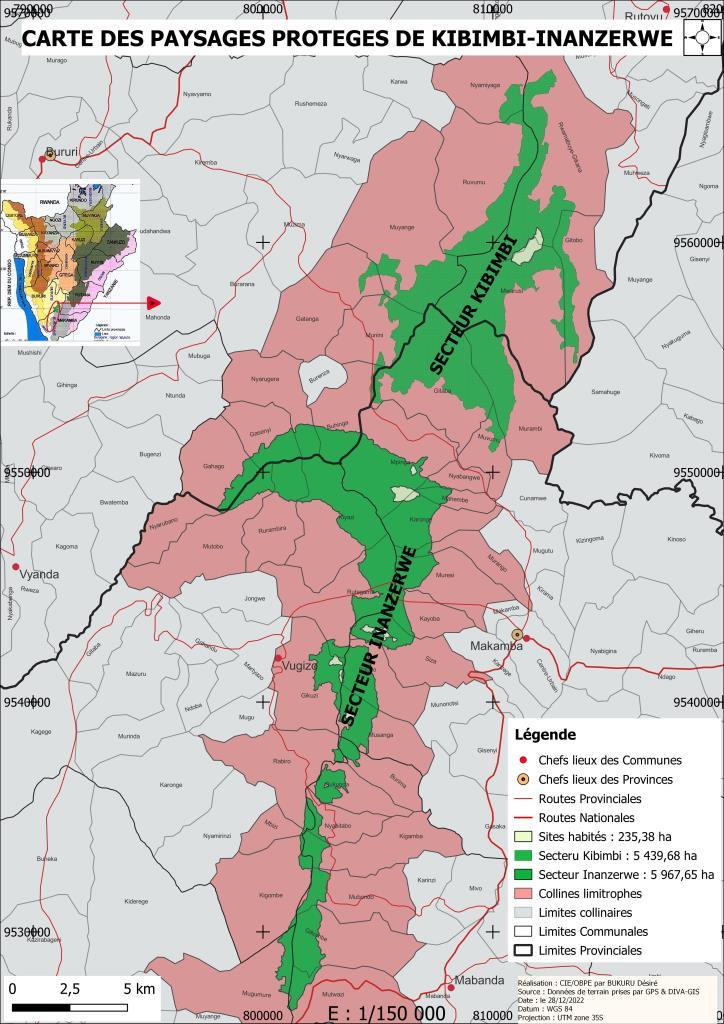
The boundaries were then, at first, determined by GPS coordinates, then marked with paint and the fixing of the terminals. The map below shows the limits of PPKIs. To produce it, OBPE technical teams went to the field to take geographic coordinates using GPS, in consultation with hill leaders and local populations. It is therefore a georeferenced map with a well-determined area of 11,642.71 ha including 5,967.65 ha for the Inanzerwe massif, 5439.68 ha for Kibimbi and 235.38 ha occupied by the populations.
Importance for the protection of the Kibimbi-Inanzegwe mountains
2010, CBD Parties adopted twenty (20) Aichi Targets to meet five main strategic goals, namely (i) managing the underlying causes of biodiversity loss, (ii) reducing direct pressures, (iii) improving the status of biological diversity, (iv) improving the status of biological diversity, (iv) strengthening the benefits derived from biodiversity and, (v) strengthening the implementation of nature protection. Protection of the plant and animal diversity of the site
The small open forests, forest galleries and grassy savannah that cover certain areas of the mountains play an essential role in terrestrial and aquatic ecology. These plant formations have important roles in the conservation of animal species, the protection of soils and the hydrological regulation of rivers whose sources are located in the mountains. They also make it possible to maintain soils thanks to root systems, to improve soil cohesion and therefore to strengthen their mechanical properties.
Protection of socio-economic value
PPKIs contain a variety of natural resources that, when maintained under good environmental conditions, would continuously provide coastal communities with important social and economic services. This ecosystem is a water tower in the South in the same way as Kibira in the North. These are the Mutsindozi, Nyengwe and Rwaba rivers in Makamba province and the Siguvyaye rivers (2.75 MW) on which a Nyemanga hydroelectric dam has been built and the current project to build another dam on the Jiji-Murembwe rivers (49.5 MW). In addition to electricity production, water sources and rivers are used to supply drinking water and to irrigate fields in order to increase rice production in the Moso and Imbo regions.
“the medicine that the earth gave them.”
In the mountains, there are also other resources used in pharmacopoeia to treat various diseases but also to generate income for traditional practitioners and other knowledge holders; straw used in stables to obtain manure in order to increase agricultural production in order to increase agricultural production, the basis of the national economy and households; wood and non-wood products (wood, fruits, termites, medicines, meats, straw...) essential for local communities.
Protection of eco-tourism value
The PPKIs represent important eco-tourism assets for Burundi. Raised to altitudes of up to around 2500 m and suitable for hiking exercises, these mountains offer an exceptional panoramic view of all four geographical points. They extend from West to East over a relatively long distance. The Kibimbi massif is interspersed with that of Inanzegwe by the road joining the capitals of Bururi and Makamba provinces.
The hills of these mountains have very steep slopes and are embedded deeply by valleys covered by lush and flourishing vegetation with an exciting biological diversity. Based on tourist facilities, it would be possible to establish footbridges that would make it possible to join two neighboring hill peaks and to enjoy the opportunity to observe the biodiversity of the valleys above. This would also allow for a rapid passage of hikes.
Because of the intrinsic attractions of PPKIs, other factors can motivate tourism in the mountains. These include the thermal waters of Muyange in Bururi commune; the proximity of the thermal waters of Muhweza in the commune of Rutovu, the Rutovu pyramid, the southernmost source of the Nile River and the Bururi NWA, which is home to a species of Chimpanzee (Pan troglodytes), which is very popular with tourists;... are all obvious tourist assets to exploit.
 |
|
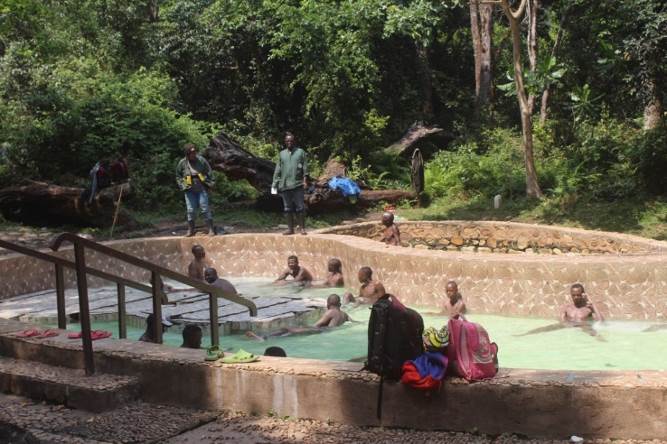
Indeed, the thermal waters of Muyange located near the city of Bururi are places of relaxation for many people who come to swim there. Their attendance is currently on the rise following the arrangements made by the OBPE so that swimming takes place in very good hygienic conditions. Those of Muhweza in the town of Rutovu are also frequented by bathers but require adjustments similar to those made in Muyange. If coastal communities were sensitized, trained and supported on eco-tourism products, they would benefit from them given the increasing number of bathers recently.
Thus, to develop the eco-tourism sector in and around the mountains, the municipal authorities should encourage the private sector to invest in this area by facilitating the acquisition of plots for the construction of hotels and transit houses near the mountains, especially in Muyange and Muhweza. They should also raise awareness among populations near tourist sites to take advantage of the passage of tourists by offering them handmade products in exchange for money that may even be currencies that the country needs so much. Once developed, these sites would bring substantial income to both populations and municipalities.
Mitigating the effects of climate change
Climate change is manifested by the disruption of rainy and dry seasons with the consequences of heavy floods and prolonged droughts. However, it is well established that natural vegetation and artificial afforestations contribute to thermal regulation by mitigating daily temperature differences. Scattered here and there in the mountains, these forest ecosystems are involved in mitigating the effects of Greenhouse Gases (GHG), which are responsible for climate change. However, the latter has already had obvious radical consequences on the socio-economic life of coastal populations by affecting much more the agricultural sectors, water resources, forest ecosystems and landscapes as well as the transport and infrastructure sectors.
Research development
An enlightened survey of these mountains shows several species of flora that have not yet been identified. The same is true for wildlife but also for other aspects of interest to scientists.
PPKIs are among the natural ecosystems in Burundi that have not received particular attention from researchers. Very little information on fauna and flora is documented. Like other PAs in the country, no study has already been done there, so the PPKI must benefit from the particular attention of many researchers in fauna and flora.
For the success of this program, OBPE will have to promote cooperation with other research institutions such as local universities, both private and public and foreign, and governmental institutions such as IGEBU and ISABU. These research institutions will work in close collaboration with the biodiversity research service already operational within OBPE.
The urgent research activities are as follows:
- Conduct in-depth inventory studies (fauna and flora) and interrelationships between organisms;
- Conduct a socioeconomic study of the PA;
- Conduct a study on the rational use and potential threats of natural resources;
- Follow the dynamics of certain key taxonomic groups;
- Feasibility study of the establishment of ecological corridors connecting PPKIs and other southern PAs (Bururi RNF, Makamba PP...) for the viability of chimpanzees;
- Etc.