
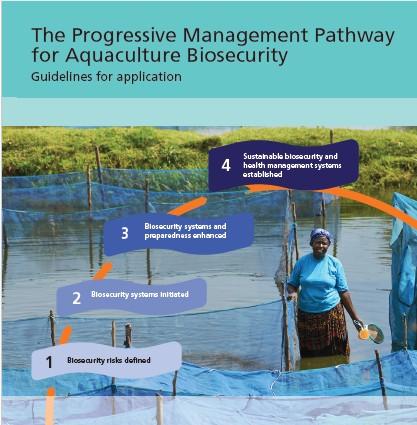
The Progressive Management Pathway for Aquaculture Biosecurity (PMP/AB) builds on existing frameworks, capacity and appropriate tools, using risk-based approaches and public–private sector partnerships. It is expected to result in the sustainable (i) reduction of burden of diseases; (ii) improvement of aquatic health and welfare at farm, national and regional levels; (iii) minimization of global spread of diseases; (iv) optimization of socioeconomic benefits from aquaculture; (v) attraction of investment opportunities into aquaculture; and (vi) achievement of One Health goals.
In the context of the PMP/AB, biosecurity refers to the cost-effective management of risks posed by pathogens to aquaculture through a strategic approach at the enterprise, local-sector, national and international levels with shared
public–private responsibilities.
This guidance document for PMP/AB application contains the rationale, vision, mission, scope, goals and benefits of the PMP/AB. The four stages of the PMP/AB are described in detail, including the overall objectives and key outcomes to complet each stage. It also presents a general stepwise process and recommended activities for completing the different stages. The PMP/AB checklist is divided into four broad categories, namely: Sectors and Stakeholders; Aquatic Health Services; Surveillance, Monitoring and Diagnostics; and Management and Evaluation.
The PMP/AB has four scenarios that provide opportunity and flexibility to any country, at whatever stage of aquaculture development, to initiate the PMP/AB by using these scenarios as entry-points: (i) countries with no national aquaculture
biosecurity strategy in place, but an aquaculture sector exists or is in the early stages of development; (ii) countries with a national aquaculture biosecurity strategy in place with some level of implementation; (iii) countries with an advanced
national aquaculture biosecurity strategy in place with full implementation; and (iv) countries whose aquaculture biosecurity is dependent on the biosecurity situation in neighbouring countries due to shared waterbodies, watersheds or coastlines and where a regional or sub-regional aquaculture biosecurity strategy is needed. Available tools that can assist in pilot testing and eventual implementation
are also presented.


