4. Sustainable production and consumption

Item index
4
Official name
Sustainable production and consumption
The uM Basin is partially covered by the Malagarazi Nature Reserve (MNR: Burundi), the latter largely corresponding to the Muyovozi Marshland complex of Burundi [3,6] (Figure 1). Furthermore, the middle Malagarazi (mM) Basin corresponds to the central stretch of the Malagarazi Basin, consisting mainly of floodplains, and extends downstream to the last rapid region below the Igamba Falls, i.e., near the village of Kasagwe (Tanzania), being at about 800 m of altitude (Figure 1). The mM Basin is partially cove
Type de document
Publication
Date de publication (du fichier / URL)
18 juillet 2024

The upper Malagarazi (uM) Basin is situated in Southeastern Burundi and Northwestern Tanzania, and partially covered by the Malagarazi Nature Reserve (MNR). A checklist of fishes from the uM, in Burundi, is presented based on a literature review, a re-examination of historical collections, and a

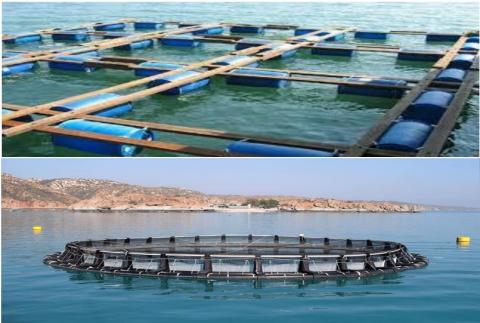
CAGE FISH FARMING POLICY  FOR THE  EAST AFRICAN COMMUNITY
Type de document
Working document
Date de publication (du fichier / URL)
1 septembre 2021
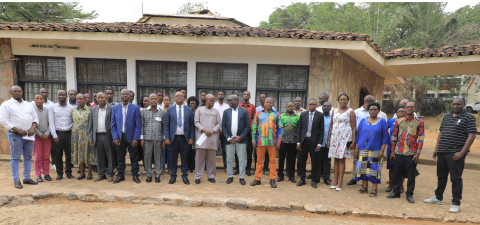
The Cage Fish Farming Policy (CFF Policy) for the EAC was prepared to fulfil obligations in Article 114 of the EAC Treaty and Article 2 of the LVFO Convention to harmonize policies for joint economic development among the EAC Partner States. Its preparation was guided by the EAC Principle of Subsidiarity, where issues to be addressed jointly within the EAC system originate from the national level, are agreed upon and harmonized at a regional level, and adopted and implemented at a national level. The evolution of the EAC CFF Policy benefited from consultations made with members of the Regional Aquaculture Working Group (ARWG) whose constructive comments and guidance shaped this policy. I also wish to acknowledge with sincere thanks staff of the LVFO Secretariat for the invaluable support they rendered during the entire period of preparation of this document Special thanks go to delegates from EAC Partner States, who constituted the Regional Team of Experts, for their active participation and invaluable contributions during the two Regional Validation Workshops, one in Arusha Tanzania on 2nd June 2021 and the second in Bujumbura, Burundi on the 21st June, 2021. Last but not least I would like to extend my sincere gratitude to all contributors who made valuable comments that improved this document ; we all helped to shape up the CFF Policy document.
Type de document
Presentation
Date de publication (du fichier / URL)
30 juin 2026

La biodiversité burundaise est une caisse d’épargne naturelle. Elle génère des recettes immédiates via la pêche, l’exploitation du bois, le tourisme, le miel et l’agriculture et sécurise les grandes filières d’exportation. Sa dégradation entrainera la perte des recettes alors que  sa gestion durable

Type de document
Report
Date de publication (du fichier / URL)
31 janvier 2021

Le lac Tanganyika joue un grand rôle dans l’économie du Pays : réservoir d’eau douce, héberge une biodiversité énorme y compris les espèces halieutiques dont on a besoin et contribue dans le transport maritime. Mais grâce à la valeur intrinsèque du lac Tanganyika, le littoral du lac Tanganyika est

Elan du Développement
E.D.

Élan du Développement - E.D.

Ensemble, bâtissons un avenir durable, juste et prospère

Née de la volonté collective de citoyens engagés, l'Organisation Non-Gouvernementale Élan du Développement (ED) est agréée par l’Ordonnance Ministérielle n° 530/480 du 20 Octobre 2025. Inspirée par les

« l’amélioration des conditions de vie (bien-être) et la préduction des inégalités »
Type de document
Agreement
Date de publication (du fichier / URL)
18 septembre 2025

Sur la trajectoire du développement, l’émergence constitue une phase déterminante et, la Vision Burundi pays émergent en 2040 s’énonce comme suit: « A l’horizon 2040, le Burundi sera un pays paisible, où chacun vit dans des conditions
décentes, où personne ne meurt d’une cause évitable, avec une