Target 21

Identifier
GBF-TARGET-21
shortTitle
21. Data, information and knowledge for decision making is available

Ensure that the best available data, information and knowledge, are accessible to decision makers, practitioners and the public to guide effective and equitable governance, integrated and participatory management of biodiversity, and to strengthen communication, awareness-raising, education, monitoring, research and knowledge management and, also in this context, traditional knowledge, innovations, practices and technologies of indigenous peoples and local communities should only be accessed with their free, prior and informed consent, in accordance with national legislation.

longDescription
Ensure that the best available data, information and knowledge, are accessible to decision makers, practitioners and the public to guide effective and equitable governance, integrated and participatory management of biodiversity, and to strengthen communication, awareness-raising, education, monitoring, research and knowledge management and, also in this context, traditional knowledge, innovations, practices and technologies of indigenous peoples and local communities should only be accessed with their free, prior and informed consent, in accordance with national legislation.
scbdTermId
7418
Type de document
Training material
Date de publication (du fichier / URL)
9 juillet 2026

Le Burundi possède 16 aires protégées réparties dans 4 catégories : Parcs Nationaux, Réserves Naturelles, Monuments Naturels et Paysages Protégés, et dans d’autres zones spéciales de protection, totalisant environ 40146 ha, soit 5,1 % du total du pays. Les aires protégées constituent un patrimoine

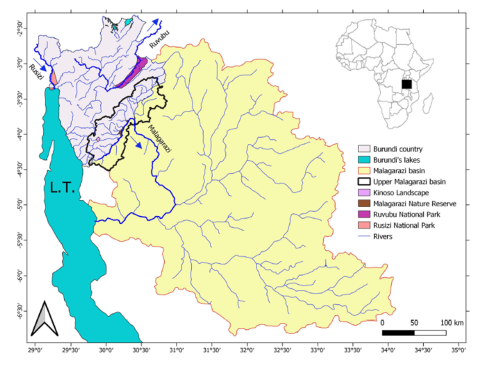
Distribution of Enteromius nzigidaherai sp. nov. (type loc.: type locality; hist.: historical sampling before 2008; rec.: recent sampling from 2008 onwards) and of its two most similar congeners also present in upper Malagarazi (uM) in Burundi, that is, E. lineomaculatus and E. quadrilineatus. The flow direction of the rivers is indicated by a blue arrow. Main affluents of the uM in Burundi (from up- to downstream): 1. Rukoziri, 2. Nyakabanda, 3. Mutsindozi, 4. Muyovozi, 5. Kinwa, 6. Mazimero, 7. Mukazye, a
Type de document
Publication
Date de publication (du fichier / URL)
1 octobre 2024

Recent collecting efforts in the upper Malagarazi basin (2013–2022) allowed for an integrative study based on qualitative (colour), quantitative (meristic and metric), and barcoding gene [mtDNA, cytochrome c oxidase (COI)] data of specimens similar to Enteromius sp. ‘ascutelatus’, being a previously

Type de document
Publication
Date de publication (du fichier / URL)
16 août 2026

Les aires protégées (AP) fournissent aux humains de nombreux biens et services. C’est pour cette raison que cette étude a pour objectif de voir l’état de gestion des AP au Burundi afin d’éviter leur dégradation. A l’aide de l’analyse documentaire, des enquêtes de terrain et des entretiens, il a été

Type de document
Training material
Date de publication (du fichier / URL)
3 juillet 2026

Face à l'intensification des pressions exercées par la croissance démographique, la déforestation, la pollution, l'urbanisation et les changements climatiques, il devient urgent de renforcer le cadre juridique afin d'assurer une
gestion durable du capital naturel et de respecter les engagements

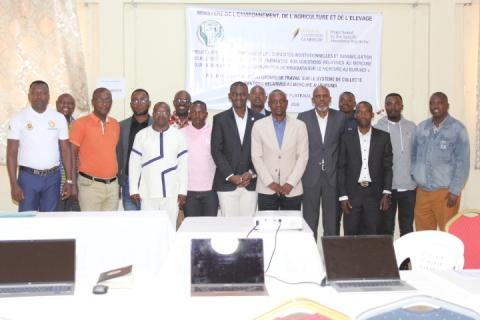
L’Office Burundais pour la Protection de l’Environnement (OBPE) a organisé, du 19 au 22 août 2026, à Ngozi, une « Réunion de formation du groupe de travail sur le système de collecte des informations relatives au mercure au Burundi ». Cette activité s’inscrit dans le cadre de la mise en œuvre du…
Type de document
Publication
Date de publication (du fichier / URL)
12 février 2026

Global food insecurity is exacerbated by population growth, climate change, and pressure on natural resources, with sub-Saharan Africa being disproportionately affected. In Burundi, diets are largely based on starchy staples that provide sufficient energy but remain deficient in high-quality protein