
Basic Page
Basic Page
Published on
2020 Jan 24Contribution to the identification of alternative host plants of Bactrocera dorsalis Hendel in the city of Bujumbura
As part of the end-of-university internships, the student MUGISHA Kelly-Garina from the University of Burundi, Faculty of Sciences, Department of Biology in 3rd year bachelor's degree completed an internship at the Biodiversity Research Service of the Burundian Office for Environmental Protection from 13/02/2018 to 13/03/2018. This student was jointly supervised by Dr. Déogratias NDUWARUGIRA, professor at the University of Burundi and Mr. Liévin NDAYIZEYE, researcher at OBPE. The general objective of this internship was to contribute to the identification of alternative host plants of Bactrocera dorsalis in the city of Bujumbura.
The specific objectives of this internship were:
-Know the different techniques for harvesting, identifying and maintaining insects;
-Learn how to set up zoological collections for scientific research purposes.
Study sites and fruit collection
The research focused on 9 sites selected in the three municipalities of the city of Bujumbura, namely the MUHA commune with three Kanyosha‚ Kinindo‚ Kibenga sites; the NTAHANGWA municipality with three Mutakura‚ Ngagara‚ Ngagara‚ Industrial Quarter sites and the MUKAZA municipality with three Rohero‚ Mutanga‚ Kiriri sites. The fruits collected were ripe fruits of Terminalia catappa Linn (badamier) that are still on the tree or have fallen. These fruits were picked and then put directly into black bags to avoid contamination by other insects.
Incubation process
The fruits collected were sent directly to the OBPE laboratory for incubation. In the laboratory, fruits were washed, counted and weighed. The fruits were then placed in plastic boxes, which were tightly closed and transparent to clearly see the flies that emerged. These boxes contained fine sand that served as a medium that facilitated pupation. The boxes‚ had labels indicating the collection site‚ the name of the fruit‚ the number of fruits collected and their weight. Finally, these boxes were placed on metal shelves protected from predatory insects, in this case the ant. Regular visits were carried out to see if flies emerged. The flies did not all emerge at the same time, which is why the fruits were not thrown away after the first flies emerged, but they were kept until they were completely decomposed.
Recovery of emerged fruit flies
The flies emerged from the incubating fruits were recovered using a mouth aspirator and then placed in bottles containing 70% alcohol. These bottles contained labels indicating the name of the fruit‚ the site where the fruits were harvested, the number of individuals caught and the date the flies emerged.
Identification and sorting of caught species
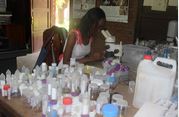 |
First the specimens were counted and labelled. Then, the captured specimens were separated on the basis of morphological characters‚ commonly known as separation by morphospecies. This separation was carried out using a stereomicroscope. Identification was carried out using an identification key for African fruit flies developed by Ekesi and Billah (2007). |