
Basic Page
Basic Page
Published on
2020 Jan 16Contribution to the study of the interrelationships between pollinators of artificial afforestations, fallow lands and riparian agricultural environments in the central plateaus, case of Gitega Province
This study was carried out in the central plateaus of Burundi, in Gitega province. The name of the central plateaus refers to most of central Burundi, from the eastern slope of the Congo-Nile ridge to the depressions in the East and North-East. They occupy 52% of the total national area. The collection was made in agroecosystems consisting of eucalyptus afforestation, fallow land and crops from November 2010 to June 2011. The present work was carried out by:
MPAWENIMANA Alexis
Under the supervision of:
- Mr. Benoît NZIGIDAHERA, Biodiversity Research Manager at the National Institute for Environment and Nature Conservation (INECN)
- Prof. Bernadette HABONIMANA, Professor at the University of Burundi, Faculty of Agronomy and Bio-Engineering (FABI), Department of Environmental Management and Ecology.
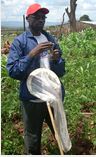 |
Field work consisted of collecting insects using various methods. These include the entomological net, Malaise Trap (alcohol or insecticide) and jars filled with detergent water. In the case of the Malaise trap, 2 traps were always used in parallel and without interruption, one in an agricultural environment, the other in the nearest artificial afforestation or fallow land to finally highlight the types of interrelationships that may exist between these different environments. |
|
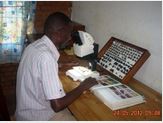
| The first determination step consisted in separating the specimens and grouping them according to their resemblance by Morphospecies. The different groups were separated under binocular and books containing determination keys were used. Wing venation has been one of the main differentiating characteristics of the various orders, families, and genera of insects. | 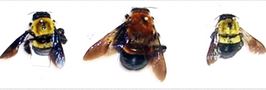 |
The comparison of the global fauna of artificial, fallow afforestations and their coastal agricultural environments in the central plateaus was made using various methods of analysis of the results. The present research has improved knowledge on pollinating entomofauna in the study area and has given results constituting good material for the awareness of everyone for the conservation of these human auxiliary beings.
Publications published:
1. Bees of the genus Meliponula Cockerell, 1934 (Hymenoptera: Apoidea), potentiality for meliponiculture in Burundi
2. Abundance and distribution of bees of the genus Xylocopa Latreille, 1802 (Hymenoptera: Apoidea) from Burundi
3. Dominance of Apis mellifera L. (Hymenoptera, Apoïdea) in natural ecosystems and agro-ecosystems in Burundi: risk of erosion of wild bee fauna