
Basic Page
Basic Page
Published on
2020 Jan 24Contribution to the systematic study of pollinating insects collected using yellow bins in agricultural areas bordering the KIBIRA National Park: case of the RWEGURA sector
From February 13 to March 13, 2018, the student NIYONGERE Chantal from the University of Burundi, Faculty of Sciences, Department of Biology in 3rd year Baccalaureate completed a training internship at the Biodiversity Research Service of the Burundian Office for Environmental Protection (OBPE) under the supervision of Dr. NDUWARUGIRA Déogratias from the University of Burundi and Mr. NDAYIKEZA Longin from the OBPE. The general objective of this work was to make a systematic inventory of pollinator species in agricultural areas bordering the KIBIRA National Park.
The specific objectives were:
- Know the different techniques for harvesting, identifying, analyzing and maintaining the specimens that have been collected;
- To improve knowledge on pollinating insects in agricultural areas bordering the PNK.
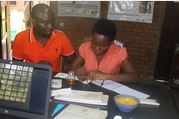 |
Initially, the specimens collected were mounted on entomological pins of variable size depending on the size of the insect to be pinned. The pin was pressed vertically into the right half of the scutum. The pin should protrude about one centimeter above the insect to allow it to be grasped without damaging it. In any case, the animal should never be fixed too low on the pin because space must be left for the labels. The smallest specimens were advantageously glued to the tip of a Bristol cardboard sequin. |
Then, the pins were fixed in appropriate boxes that will be kept in the OBPE biodiversity laboratory where they will be used as needed for further research. Each sample was labelled with information on the location where it was collected (country, province, province, site, altitude), the date the insect was caught, the area where it was harvested, and the name of the collector.
After these activities of pinning the specimens, the student proceeded to identify the pinned insects. The first determination step consisted in separating the specimens and grouping them in order according to the simple criterion of having only two wings for the Diptera and four wings for the Hymenoptera. The different groups were separated under a binocular microscope while consulting the books containing the determination keys (Connal et al., 2010 and Stephen and Marshall, 2006), after distinguishing the different characteristics under a microscope. Collections made and preserved at the OBPE also served as a reference in this work.
Wing venation has been one of the main differentiating characteristics of the different orders, families and genera for these insects. But also, the position of the pollen-collecting structure on the body of the insect served as another criterion for determining these insects. Thus, the Apidae are subdivided into 7 families which are distinguished in particular by the morphology of their pollen and nectar collection devices. Other criteria such as the presence or absence of hair on the body of the insect, the color of the abdomen and the appearance of the body (shiny, metallic) were considered.