
Basic Page
Basic Page
Published on
2020 Jan 23Course of the course on invertebrates in Protected Areas
 |
From January 18 to February 19, 2016, Miss Ntawuyankira Neilla is a student at the University of Burundi, Faculty of Sciences, Department of Biology in 3rd year Baccalaureate a training course at the Burundian Office for Environmental Protection OBPE under the supervision of Dr. SIBOMANA Claver, professor at the University of Burundi and NZIGIDAHERA Benoît from the OBPE. |  |
Each year, the University of Burundi organizes internships for finalist students in collaboration with various institutions, both state and private, and it is within this framework that the present internship was organized. The present internship concerned the invertebrates preserved at the OBPE in the service of Biodiversity Research and especially insects.
After contact with the internship supervisors, during which the objectives of the internship were defined and working techniques were put in place, the work of the internship began with the handling of specimens preserved in alcohol. The first step was to check whether or not the available jars had a label indicating the date, location, harvesting method and the name of the harvester.
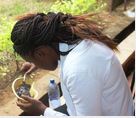 |
Then the trainee rinsed with alcohol and then removed what was not concerned by the study. Using forceps, the specimens were placed on an absorbent plate so that the plate absorbed all moisture. The next step was pinning, where entomological pins of variable size were used depending on the size of the individual to be pinned. | 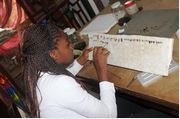 |
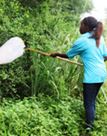
Care was taken to leave 1cm above the animal in order to facilitate handling, then the wings were brushed to spread them out. The specimens were left to dry on a polyethylene support for 24 hours. The period from 25 to 29 January was concerned with the labeling of pinned specimens as well as those preserved there without individual labels. The label includes the location, date, harvest environment, and sampling method. Next, grouping into more or less homogeneous groups was carried out by observing the directly visible characters.
 |
Individuals were distinguished from each other using a magnifying glass and a stereomicroscope by considering the various characteristic identifying traits. was organized | 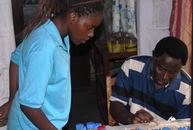 |