
Basic Page
Basic Page
Published on
2020 Jan 24Course of the course on the systematic study of pollinating insects in Kibira National Park: Case of the Rwegura sector
 |
From February 20 to March 31, 2017, Miss NDUWAYO Odile from the University of Burundi, Faculty of Sciences, Department of Biology; 3rd Baccalaureate completed a training course at the Burundian Office for Environmental Protection (OBPE). The supervision of this internship was provided by Mr. CUBAHIRO Arnaud, Assistant at the University of Burundi and Msc. NZIGIDAHERA Benoît from OBPE. |  |
This internship was carried out as part of annual internships organized jointly between the University of Burundi and other research institutions, both state and private. This course focused on “The systematic study of pollinators in Kibira National Park: case of the Rwegura sector”.
The work relating to this internship began by contacting the head of the biodiversity research department during which the student learned about the working methods. The objective of this internship was to contribute to the knowledge of pollinators in Kibira National Park, Rwegura sector.
| After making contact, the student began her internship by preparing samples stored at the OBPE in jars containing 70% alcohol. These samples were placed on an absorbent plate and then cleaned with a brush. The legs and wings were spread out perpendicular to the body. Then, the samples were pinned to the chest in the right side of its half. | 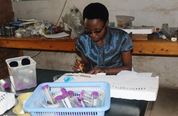 |
 |
Then, the student labelled the collected specimens. The label had the name of the collector, the place of harvest, the date, the country, and the name of the plant from which the insect was collected. The specimens were then placed in glass boxes lined with a foam base for preservation. The deposit of these boxes in the cabinets was preceded by putting them in the refrigerator to prevent these specimens from being damaged by microorganisms. |
| The next step was to group morphospecies the various samples in the boxes according to directly visible morphological similarities such as size, color, etc. Finally, the student systematically analyzed the samples, using a determination key and a stereomicroscope; to give the provisional scientific name of the sample while waiting for verification by a specialist from the Royal Institute of Natural Sciences of Belgium (IRSNB). | 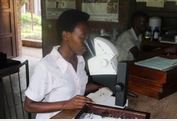 |
This internship was an opportunity for the student to learn the various techniques used in the study of insects, which is an asset for integrating into the professional environment.