
Basic Page
Basic Page
Published on
2020 Mar 23Mini workshop to validate the study document on natural ecosystem trends: Case of the Rumonge Nature Reserve and the Kigwena and Vyanda Forest Nature Reserves in Burundi
On February 26, 2020, a mini-workshop was held to validate the study document on trends in natural ecosystems: Case of the Rumonge Nature Reserve and the Kigwena and Vyanda Forest Nature Reserves. This was organized as part of the program of research, information exchange, awareness-raising and biodiversity conservation.
Were present:
2 professors from the University of Burundi, 5 managers from the Burundian Office for Environmental Protection (OBPE) and 1 CHM assistant.
Welcome word
At the start of the mini-workshop, the Program Manager for Research, Information Exchange, Information Exchange, Awareness and Conservation of Biodiversity, said the welcome speech by thanking the participants who had responded to this invitation. Subsequently, he emphasized that in order to implement the National Strategy and Action Plan on Biodiversity (SNPAB 2013-2020), Burundi has already begun to conduct studies to formulate indicators in order to analyze the trend of biodiversity in particular and ecosystems in general. Subsequently, he emphasized that in order to implement the National Strategy and Action Plan on Biodiversity (SNPAB 2013-2020), Burundi has already begun to conduct studies to formulate indicators in order to analyze the trend of biodiversity in particular and ecosystems in general.
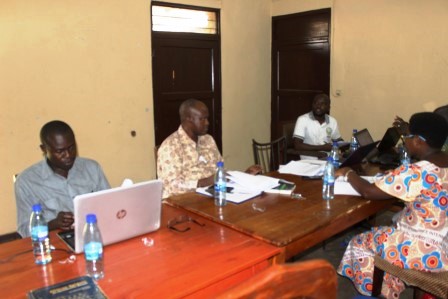 |
He also noted that this study was part of the same framework but specifically for the natural ecosystems of the Rumonge Nature Reserve and the Kigwena and Vyanda Forest Nature Reserves. He thus reminded the participants that the objective of this mini-workshop was to validate the study document and that their observations and suggestions would contribute to its improvement so that it would be useful for the sustainable management of protected areas. |
| Welcome by the Head of the Research Program, Information Exchange, Awareness and Biodiversity Conservation |
Presentation of the document
The presentation was made by one of the three members of the team that carried out the study. Introductively, he said that the overall objective of this study was to formulate indicators to monitor the trend of ecosystems in the Kigwena Forest Nature Reserve, Rumonge Nature Reserve and Vyanda Forest Nature Reserve.
|
He lamented that the management of these 3 protected areas remains a problem as conservation decisions are not based on scientifically collected information. |
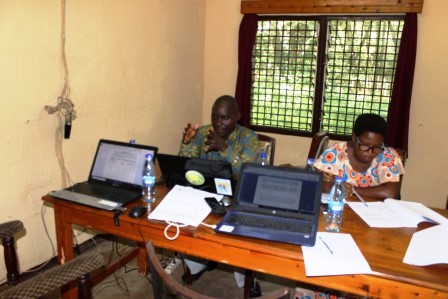 |
| Presentation of the study document |
Subsequently, he emphasized that the objectives pursued for this study were as follows:
- Data collection and information on the trend in the areas of these PAs;
- Data collection and information on the trend of the various key conservation species;
- Formulation and dissemination of indicators based on the data and information collected
- Establishment of a database to monitor the trend of these APs over time
Afterwards, the presenter explained the methodology used to achieve these objectives. According to his words, to collect and analyze the data, the following methods were used:
- Collection of numerical data on the areas (ancient and current) of the ecosystems of the areas that were the subject of this study through scientific studies, reports, decrees delimiting protected areas and other documents.
- Tracking changes in the occupancy of ecosystems studied using the Trends.Earth extension (formerly the Land Degradation Monitoring Toolbox) using Earth observations in an innovative desktop and cloud system. The Trends.Earth extension made it possible to plot time series of key indicators of land change (including degradation and improvement). These indicators were established in the form of maps showing the situation of these PAs between 2001 and 2015;
- Collection of geographic coordinates using GPS to verify the georeferencing of existing maps of the study area.
He added that an interview guide has been designed in such a way as to provide information on several aspects, among others:
- the data encrypted in a temporary sequence of certain species.
- plant and animal species used by the population for subsistence and/or commercial purposes;
- the different types of ecosystems in the protected area;
- main plant species by formation;
- main threats to species or ecosystems
- key conservation elements;
- species of paramount importance in the survival of the population living near these protected areas;
Finally, the analysis of the degree of threat of species was based on simplified and referenced criteria for the classification of endangered species, but not identical, to those of the IUCN for endangered species.
Before presenting the results, the presenter emphasized that in the absence of data from previous years, the indicators provide a baseline situation in this document that serves as a basis for monitoring trends in these PAs. Indicators are therefore maps, tables and graphs showing the state of play of these ecosystems.
Regarding the trend of the 3 protected areas studied in terms of extent, the results found showed that although these APs are undergoing degradation, their areas have remained intact.
From the point of view of trend in terms of species by ecosystem, at the Rumonge Nature Reserve, the results revealed that some species have not undergone visible changes over time. These include Brachystegia sp., Uapaca sp., Combretum collinum. On the other hand, species like Cordia africana and Sterculia quinqueloba, which were rare in 2000, became endangered and vulnerable respectively in 2018. Finally, the species Chlorophola excelsum, which showed signs of vulnerability in 2000, is currently threatened with extinction. At the Kigwena Forest Nature Reserve, the results showed that all plant species considered by managers as key elements of conservation were all rare in 2000. In 2018, the status remained the same, except for the species Chlorophola excelsum, which has become endangered. And finally, at the Vyanda Forest Nature Reserve, the results show that the situation in 2000 remained almost the same until 2018. The species Cordia africana and Chlorophola excelsum are in danger of completely disappearing in the Vyanda reserve if nothing is done to save them.
In terms of evaluating degradation indicators, the study focused on sub-indicators of land cover and soil organic carbon production only for each of the three reserves studied. The results showed that during the period 2001-2019, the Rumonge Nature Reserve experienced an estimated gain in biomass of 324,090 tons of CO2e, which reflects an increase in its forest cover. The biomass of the Kigwena Forest Nature Reserve has experienced a gain of 176,141 tons of CO2e, which also reflects the increase in its forest cover. An increase in forest cover was also observed at the Vyanda Forest Nature Reserve, whose biomass experienced a gain of 3,048,791 tons of CO2e during the period 2001-2019.
In conclusion, the presenter mentioned that this study complements information from previous studies on biodiversity trends in Burundi. He added that this study, through its results, showed that these 3 protected areas (Rumonge Nature Reserve, Kigwena and Vyanda Forest Nature Reserves) have undergone changes over time. The status of some key species for conservation has been established. Threats have been identified in each protected area.
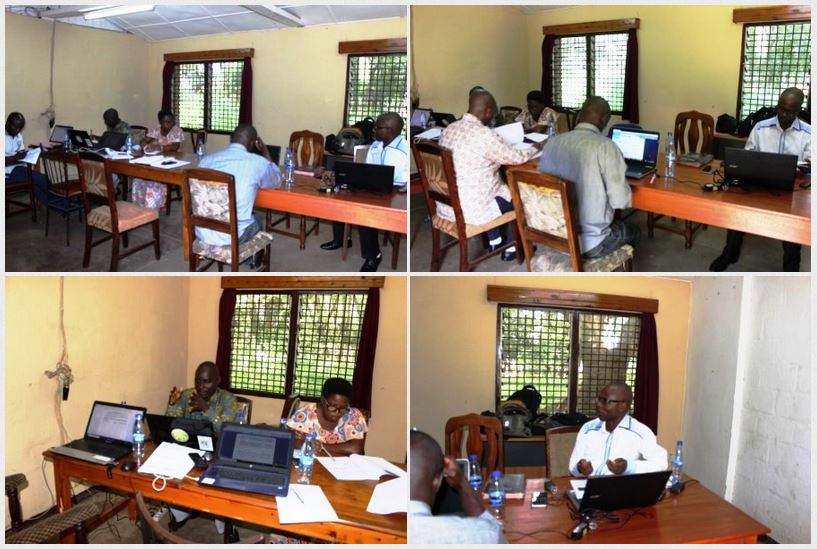
After this presentation, discussions on the study document. As a result, some improvements have been suggested and recommendations have been made.
|
| Exchanges between participants on the study document on natural ecosystem trends: Case of the Rumonge Nature Reserve and the Kigwena and Vyanda Forest Nature Reserves |
The recommendations made at the end of this study are as follows:
- Strengthen the capacities of OBPE managers in GIS and remote sensing;
- Train eco-guards on appropriate techniques for monitoring the evolution of species
- Make an inventory of fauna and flora with an emphasis on key conservation species;
- Increase the frequency of patrols in order to fully understand the state of these protected areas
- Increase the number of eco-guards in order to strengthen the integrity of these protected areas
- Equip and strengthen the OBPE GIS department for daily data collection;
- Disseminate the indicators through awareness-raising workshops for curators, researchers and decision-makers.
Finally, the mini-workshop was closed with words of thanks from the person responsible for the Research Program, Information Exchange, Awareness and Biodiversity Conservation to the participants for their fruitful interventions.