
Basic Page
Basic Page
Published on
2020 Mar 03Report of the mini workshop of organizations with projects financed by Belgium
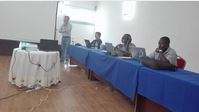 |
On 10/4/2018, the Embassy of the Kingdom of Belgium in Burundi in collaboration with the Burundais Office for the Protection of the Environment (OBPE) organized at the Restaurant La Détente in Bujumbura, a mini workshop for organizations with projects financed by Belgium. |
This meeting follows the informative meeting held in October 2017 in the premises of the OBPE liaison office with the objective of reflecting on possible ways of complementarities between the projects. This mini workshop saw the participation of OBPE managers and staff, the coordinator of the CeBIOS program, the Focal Point of the CHM-Belge, the delegate of the Belgian Embassy, the representatives of CSA/CAPAD (Confederation of Associations of Agricultural Producers for Development), the NGO Entraide et Fraternité, the NGO Entraide et Fraternité, of VSF-B and of the NGO B.D.
The activities of this mini workshop were opened by the Director General of OBPE who welcomed the participants to this mini workshop, specifying that this meeting aims at collaboration and complementarity between Belgian partners. Afterwards, the Focal Point of the Belgian CHM, Mr. Han de Koeijer, took the floor and informed the participants that this meeting was part of the mid-term evaluation of the CEBiOS programme. He also informed them that this meeting follows two other meetings during which the results of the 2014-2018 programme were presented followed by the formulation or proposal of activities for the 2019-2023 programme. You have been invited to this workshop to contribute to the development of strategies for the next five years, he said. He ended his speech by saying that the contributions of Belgian partners are of great importance for the promotion and conservation of biodiversity in Burundi.
After this statement by the PF of the CHM-Belge, the Director General of the OBPE, Dr. Samuel NDAYIRAGIJE gave a welcome speech to the participants. He began his speech by telling the participants that this workshop is part of NGOs with projects financed by Belgium on the environment. It is then important to sit down together to discuss the ways and means that we can deploy to succeed in the mission given to us without, however, getting in the way, he said. Close collaboration is required to preserve our environment and contribute to the development of Burundi. He ended his speech by thanking the Belgian Embassy for this good initiative, and thanking the participants for attending this workshop.
| The DG's speech was followed by a word of circumstance from the delegate of the Belgian Embassy in Burundi focusing on the long-standing collaboration between the OBPE and the Belgian Institute of Natural Sciences (IRNSB). He noted that a lot of activities have been carried out through this partnership, which is always fruitful. He did not fail to point out the electricity supply to the Burundi Information Exchange Center on Biological Diversity located at the OBPE liaison office. | 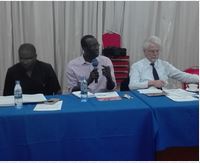 |
He ended his remarks by mentioning that the specific objective of this mini-workshop is to maintain collaboration between the various organizations working for the protection of biodiversity in Burundi and that Belgium is ready to support this framework of collaboration of partners with projects under its funding.
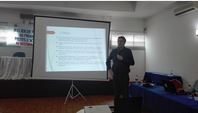 |
Afterwards, a session of presentations of the CeBIOS program followed by Luc Janssens de Bisthoven, coordinator of the CeBIOS program. At the beginning of his presentation, he first spoke about the strategic objectives of CEBIOS which are (a) knowledge, research, (b) information, CHM, (c) awareness raising, (d) policy integrations, (e) MRV, (f) Nagoya Protocol. |
Then, he spoke about the functioning of CEBIOS, which takes the form of calls for projects for training courses, public awareness, etc. He took this opportunity to talk about the objective of their mission in Burundi, which is the formulation of the plan for phase II (2019-2013), which is the formulation of the plan for phase II (2019-2013) after phase I (2019-2013) after phase I (2014-2018), which ended on Monday with the presentation of the results and the formulation of recommendations for future activities. He also said that this mini workshop engages Belgian actors for complementarity and synergy.
Continuing his remarks, he talked about the global challenge that CeBiOS wants to face, which is to protect, conserve, restore the remaining biodiversity of our planet, and use and manage it in a sustainable way to stop the sixth extinction. He thus spoke about the causes of the decline in biodiversity (demography, ignorance, ignorance, poaching, poverty, exclusion of women) and that CeBios supports the creation of a sustainable ecological system. He continued his presentation by talking about the support of CEBIOS to the OBPE on the CHM, collections and library, research and the valorization of ecosystem services (pollinators, mushrooms), the monitoring of the dynamics of habitats and the biodiversity of protected areas, the monitoring of the dynamics of habitats and the biodiversity of protected areas, the awareness of decision-makers and policies. He did not fail to present the other supports provided to the OBPE with regard to the Nagoya Protocol, the organization of the ABCtaxa series in the service of (para) taxonomy, support for policies (decision-makers) based on science (policy briefs), support for the implementation of the Nagoya Protocol of the Rio CBD Convention in Burundi, the development of a tool (lexicon) for Kiwi plants (policy briefs), support for the implementation of the Nagoya Protocol of the Rio CBD Convention in Burundi, the development of a tool (lexicon) for Kiwi plants By experts from OBPE and the University of Burundi, lexicon in preparation for the RUVUBU National Park and the monitoring of the shores of the Lake Tanganyika.
He ended by presenting the ideas put forward during the last two workshops as recommendations for phase II (2019-2023), in this case the continuation of the existing components while refining them. As a press release, he spoke about the biodiversity conference that will be held soon and invited participants to register on the CeBIOS website.
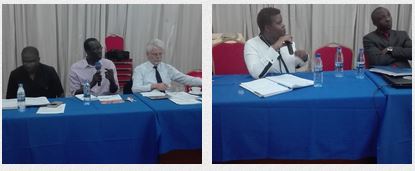
After this presentation, participants gave their suggestions and concerns.
During this mini-workshop, the following recommendations were made:
-Develop awareness-raising tools that meet the needs of the moment;
-Advocate for the climate change project;
-Conduct a study that would allow us to meet the needs of populations (food) and protect the environment (OBPE);
-Strengthen synergy through training;
-Undertake awareness-raising actions for the protection of the environment through income-generating activities;
-Continue the supervision of protected area guards, continue to assist converted poachers to ensure the preservation of protected areas;
-Train forest rangers (internships in neighboring countries) to strengthen their capacity;
-Multiply bamboo to create a source of income for the Burundian population;
-Erect new protected areas (currently protected areas occupy 6% of the national territory);
-Strengthen collaboration with people from the Ministry of Agriculture, especially at the level of wetlands (duality between food and environmental protection);
-Restore the breeding of small livestock to obtain manure in order to avoid the use of chemical fertilizers that destroy the soil miserably;
-Make the results of research carried out at the OBPE level accessible;
-Organize environmental meetings (bringing together the various partners to give them an overview of biodiversity).
|
This workshop was closed jointly by the CEO of OBPE and the delegate of the Belgian Embassy thanking the participants for their contributions and wishing them a good return to their respective environments.