
Basic Page
Basic Page
Published on
2020 Mar 05Report of the workshop to validate the guide to raise awareness among farmers, NGOs, palm oil owners and donors on the importance of rattan for its restoration
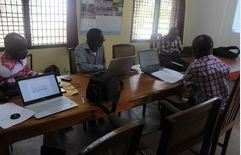 |
On August 21, 2018, within the premises of the liaison office of the Burundian Office for Environmental Protection (OBPE) located in Jabe, a workshop was held to validate the awareness-raising guide for farmers, NGOs, oil palm owners and donors on the importance of rattan for its restoration. This workshop is part of the Program for Research, Information Exchange, Awareness and Conservation of Biodiversity under the funding of the Royal Institute of Natural Sciences of Belgium (IRSNB) through the CeBIOS program. |
| The activities of this workshop began with an opening statement from Mr. Masabo Onesphore, head of the research program, information exchange, awareness-raising and biodiversity conservation. In his opening remarks, he said that the OBPE had given a task to a consultant to write an awareness-raising guide for the effective involvement of all stakeholders in the restoration of rattan (Eremospatha haullevilleana) in Burundi. | 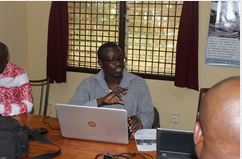 |
Afterwards, he informed the participants that they were invited to this workshop to analyze and enrich the document produced before proceeding with its validation. He ended his remarks by inviting the designer of the guide to present its content to the participants.
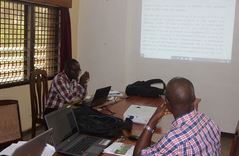 |
This opening speech was followed by the presentation of the guide by the resource person Mr. NTASHAVU Dieudonné. His presentation began with a brief introduction highlighting the importance of rattan, the research already done on rattan and its main conclusions, not to mention the current state of affairs on rattan exploitation. He continued his presentation by screening the document whose content is based on five points, namely the description of rattan and its environment, the uses and threats of rattan, the constraints related to the sustainable management of Non-Timber Forest Products (NTFP), the restoration of rattan and the conclusion. |
The guide contact person provided clarification for each point mentioned in the guide. During this presentation, the participants in agreement with the resource person proposed to make corrections at the end of each component point of the presentation.
|
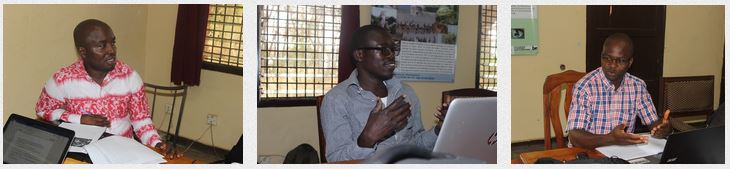
To all the questions, suggestions and comments made by the participants, Mr. Ntashavu Dieudonné, producer of the guide, provided clarifications. After this session of analysis and correction of the document, the workshop was closed by the program manager, Mr. Masabo Onesphore, who thanked the participants, in this case Dr. NDUWARUGIRA Déogratias from the University of Burundi, Faculty of Sciences, for participating in the analysis session of the document on rattan, for participating in the analysis session of the document on rattan and reiterated the resource person to integrate all participants' contributions into the document before its validation. definitive.
During this workshop the following recommendations were made:
- Since rattan is a species in the same family as oil palm, it was recommended that a study be carried out on the impact of rattan on oil palm and vice versa;
- It was also recommended that sentences containing authors be restructured to better cite them in the document;
- Taking into account the concerns of palm grove owners regarding the cultivation of rattan under the palm grove, it was recommended to conduct a domestication test outside the palm groves;
- To make a rational exploitation of rattan, it was recommended that a study be carried out to find out the rattan stock available in the national territory.
- Knowing that the exploitation of rattan was carried out in the absence of data on the available stock, it was recommended to mention in the document the error made by the OBPE in granting the permit to exploit rattan;
- It was also recommended to integrate OHP frameworks into the actors to be sensitized;
- In order to better understand the ecology of rattan, it was recommended to conduct studies to find out all the species of plants that can coexist with rattan.