
Basic Page
Basic Page
Published on
2020 Jan 15Studies of spiders in forest and agricultural ecosystems
Even though all organisms contribute to the functioning of ecosystems, there are some that provide more essential services, such as spiders. These play an irreplaceable role in indicating the state of health and the evolution of ecosystems in Protected Areas. They are also recognized as excellent ecological indicators that allow the structures and environmental components of an environment to be characterized very precisely. One could ask whether these spiders can be used as indicators in monitoring the evolution of habitats in the ecosystems of our Protected Areas. On the other hand, spiders can be used in the reduction of pests in cultivated plants in order to reduce the harmful effects of pesticide use on the environment and human health. Thus, they would be involved in biological control, which would make it possible to increase agricultural yields and manage to ensure the food security of the population.
In Burundi, studies on the araneofauna of the soil have been done and we already know about soil spiders. Despite this step already taken, we do not know the role played by these spiders in indicating the health of ecosystems as well as their role in reducing plant parasites. It is in this perspective that 2 studies, one on the systematic and ecological study of spiders in the Kibira National Park: Case of the Rwegura sector and the other on the Analysis of araneological populations and their influence in the reduction of parasites in the agroecosystems of Western Burundi (Isale and Mubimbi): Case of coffee trees and banana plantations were conducted. These studies were initiated in the framework of collaboration between Mr. Nzigidahera Benoît (Biodiversity Research Manager at INECN) and Ms. Professor Habonimana Bernadette (University of Burundi, Faculty of Agronomy and Bio-Engineering (FABI), Department of Environmental Management and Ecology (University of Burundi, Faculty of Agronomy and Bio-Engineering (FABI).
1. Systematic and ecological study of spiders in Kibira National Park: Case of the Rwegura sector
 |
Sampling was carried out on 8 sites, chosen along a well-delimited transect using interception traps or Barber trap (pitfall trap). | 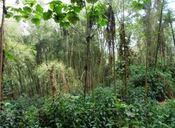 |
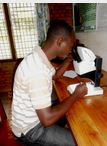
For a study site, the traps are installed in various locations selected randomly. In total, 24 traps, at the rate of 3 traps per site, were installed on this transect. The captures were carried out continuously for a period of 6 months, from February to July 2013, and the traps are emptied and restarted every 15 days. The determination was carried out using a binocular stereomicroscope. The results were analyzed on the basis of various indices to characterize the composition of spiders in different sites in the study area.
2. Analysis of araneological populations and their influence in the reduction of parasites in the agroecosystems of Western Burundi (Isale and Mubimbi): The case of coffee trees and banana plantations
The present research took place in the municipalities of Isale and Mubimbi in the province of Bujumbura. These municipalities are located in the agroecological zone of Mumirwa, which constitutes a transition between the high peaks of the ridge and the Imbo plain.
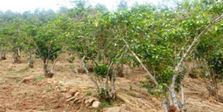 |
Spiders and other insects were sampled using the Barber trapping method and Winkler's sieving and extraction method. The traps were installed in different places in an agroecosystem chosen according to the diversity of biotopes. | 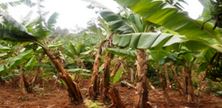 |
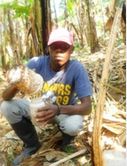 |
Two traps per agroecosystem and per locality were installed. After two weeks, the samples from two traps are transferred together into a single bottle. After transfer, the traps are reinstalled in other places in the same agroecosystem. Field work was followed by taxonomic analyses in the laboratory. Several documents containing taxonomic determination keys were consulted after binocular observation of the specimens subject to identification. At the end of the work, several species of spiders have been identified and the results obtained so far are satisfactory. |