
Basic Page
Basic Page
Published on
2020 Jan 13Study of Loranthaceae plant parasites in Burundi
In Burundi, there is currently a proliferation of parasitic plants in agro-ecosystems and in forest ecosystems. These plants from the Loranthaceae family deserve particular attention because they cause damage with an incredible loss of fruit, forest and agroforestry plants. In order to better understand this phenomenon and the Lorantaceae species involved, studies have been started in all ecological areas of the country. These studies were initiated in the framework of collaboration between supervised by Mr. Nzigidahera Benoît (Biodiversity Research Manager at INECN) and Ms. Professor Habonimana Bernadette (University of Burundi, University of Burundi, Faculty of Agronomy and Bio-Engineering (FABI), Department of Environmental Management and Ecology.
Studies of Loranthaceae plant parasites in Burundi
1. Agroecological zone of Congo-Nil Crete
These studies on Loranthaceae were carried out in 5 ecological zones of the country which are the Congo Nile Ridge, the Northern Burundi Depression, the Imbo Plain, the Central Plateaux and the agroecological zones of Buyogoma and Kumoso.
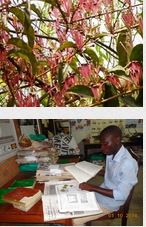 |
The agroecological zone of Congo-Nile Crete extends from North to South Burundi from North to South and the study concerned the natural regions of Mugamba and Bututsi. This study area was in turn subdivided into 4 sectors and in each sector, forest and agricultural ecosystems were explored. The sectors were in turn subdivided into sites. During data collection, for each parasitized species, parameters such as the presence or absence of the parasite, the phenological stage of the parasite (leaf, flowering, fruiting), the diameter at chest height, the total height of the tree, the height of the attack level, the height of the attack level, the number of clumps per tree and the diameter of the attack level were recorded. In each delineated plot, attacked plants were identified and for each species, samples of the host plant and the parasite species were collected. For the analysis of the results, the calculation of the infestation rate (T.I), the intensity of infestation, the abundance of the inventoried Loranthaceae, etc. were calculated. |
| NDAYIZEYE Jean Marie, student from the University of Burundi during the determination of Loranthaceae specimens |
2. Agroecological zone of the Northern Depression
The agroecological zone of Bugesera is located in northern Burundi. From a phytogeographical point of view, Bugesera is linked to the eastern domain of the Sudano-Zambezian region. The flora and plant groups in particular show a lot of affinities with those of the Kagera region and the Ankole district in Uganda. On the banks of the lakes, the malarial vegetation consisting of marshes with a predominance of Cyperus papyrus is described. At the level of the bottom of the dry valleys, a grassy savannah with Bothriochloa insculpta and Themeda triandra is observed. The xerophilous groves of Bugesera are distinguished into groves with Grewia mollis and Pappea capensi, groves with Olea europaea subsp. Africana , groves of Grewia mollis and Zizyphus micronata and groves of Pappea capensis and Celtis africana. Agroecosystems were also studied during the present work. During the study, various parameters such as the proportion of parasitized plants in an area of one hectare, height of the attack level, circumference at human height, circumference of the attacked branches and the total number of clumps on each parasitized tree were determined. Several data analysis methods were used to reach consistent conclusions and the results obtained were a contribution to the study of Loranthaceae in Burundi.
3. Imbo plain agroecological zone
| The work of the present study was carried out in the Protected Areas of the Imbo Plain, which are the Rusizi National Park, l the Kigwena Forest Nature Reserve, l the Rumonge Forest Nature Reserve, l the Nkayamba clear forest, as well as their riparian agricultural environments. In each type of ecosystem, areas of 100 m by 100 m in the invaded areas were delimited. by Loranthaceae and systematic harvesting species of lauranthaceae and their host plants were made. Measurements of the height of the host plants and that of the levels of attack as well as the circumferences of the levels of attack and the diameters at chest height of the host plants were taken each time before harvesting. | 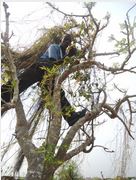 |
| NDAYISABA Gilbert, student at the University of Burundi collecting Lorantaceae samples |
4. Agroecological zone of the central plateaus
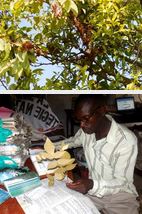 |
The present research was carried out on the central plateaus of Burundi, most of central Burundi, from the eastern slope of the Congo-Nile ridge to the depressions in the East and North-East. From a methodological point of view, the choice of sampling sites was guided by the degree of plant infestation by these hemiparasites. Parameters such as the proportion of parasitized plants in an area of one hectare, height of the attack level, circumference at human height, circumference of the branches attacked and the total number of clumps on each parasitized tree were recorded. Several data analysis methods were used during this research, which contributed to the study of Loranthaceae in Burundi. |
| SINIREMERA Protais, student from the University of Burundi during the taxonomic determination of Loranthaceae specimens |
5. Buyogoma and Kumoso agroecological zones
|
The present study was conducted to inventory and identify all hemiparasitic species of the Loranthaceae family in forest and agricultural environments, their host plants as well as their infestation rate. the study. The method adopted was to delimit an area of one hectare where the presence of parasites was observed and to carry out a complete harvest of the Loranthaceae species as well as their hosts. Each time before starting to collect the samples, measurements of the height of the host, the circumference to the chest height of the host plants, the height of the level of attack on the host, the circumference of the snow and the attack of the parasitized branch were carried out. In addition to this, the count of the clumps of the parasite on each host plant was also carried out. Finally, additional information such as the dissemination agents of Loranthaceae seeds and the probable date of their appearance in crops were collected through observations and interviews with the population of the study area. |
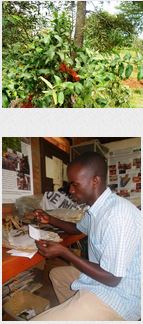 |
| University of Burundi student during the taxonomic determination of Loranthaceae specimens |