
Basic Page
Basic Page
Published on
2020 Jan 14Study of woody plants in the city of Bujumbura (trees and shrubs)
The city of Bujumbura is full of many species of woody flora involved in the stabilization of river banks, shading and the well-being of the population. In order to encourage the population to value woody plant species, research on trees and shrubs in the City of Bujumbura was carried out by Mr. NGENDAKUMANA Egide from the Ecole Normale Supérieure (ENS), Department of Biology under the supervision of Doctor BANGIRIMANA Fréderic (ENS) and Msc. NZIGIDAHERA Benoît from the Burundian Office for Environmental Protection (OBPE).
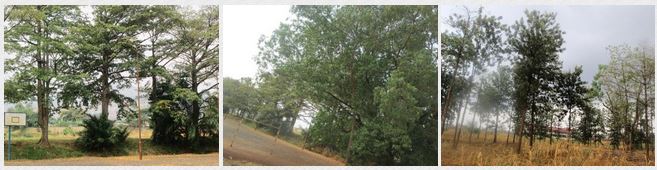
|
| Trees and shrubs in the city of Bujumbura |
The main objectives of this work were:
- make a floristic inventory and a botanical description of exotic and indigenous woody plants in the city of Bujumbura;
- provide an overview of the plant potential of the city of Bujumbura;
- show the distribution of plants (coverage and abundance) in the sampled sites in the city of Bujumbura;
- describe the role of bio-depollution and these plants for the well-being of the inhabitants of the city of Bujumbura;
- create a herbarium for each species to be kept in the OBPE herbarium to serve as a reference in future research.
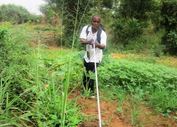 |
Field work began with the exploration of the sites to be sampled, the delimitation of the frame (measurement of length and width) as well as the inventory of woody plants in each frame. This activity was always followed by counting the individuals of each woody species found in the frame. | 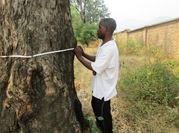 |
| Delimitation of sites |
Taking dendrometric measurements |
For each plant, the circumference and height were measured using a decameter and the Suunto dendrometer followed by taking a sample using a knife.
The samples of the plants inspected were always photographed.
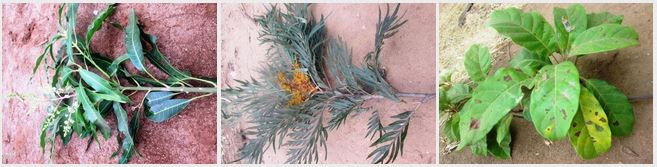
|
| Some essences of the city of Bujumbura |
| Each time, the sample of each plant was kept in the newspaper and placed in a sample press. Drying has always been done in sunlight. Information about all samples was recorded on paper and in a notebook. These include the name of the harvester, site, species name, and harvest date. Geographic coordinates were taken using a GPS. | 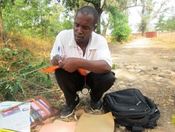 |
| Data recording |