
Basic Page
Basic Page
Published on
2020 Jan 20Taxonomic and ecological study of wild Apoidea (bees) from Burundi from 04 to 28 March 2014 at the Royal Museum for Central Africa (MRAC)
 |
From 04 to 28 March 2014, Mr. Mpawenimana Alexis, researcher at the National Institute for Environment and Nature Conservation (INECN), carried out a training course on the taxonomy and ecology of wild bees in Burundi at the MRAC d as part of the African Biodiversity Information Center (CIBA) program of the said Museum. |  |
This training took place within the Entomology section and under the supervision of Dr. Eliane De Coninck, Head of the MRAC and Dr. Alain Pauly of the Royal Institute of Natural Sciences of Brussels (IRSCnb) and under the following 3 main structures:
- Training on professional techniques for preparing and handling apoid entomological specimens;
- Taxonomic identification of specimens;
- Data collection on bees of the genus Chalicodoma.
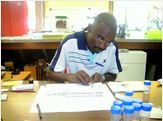 |
Training in professional techniques for preparing and handling specimens took place at IRSCnb. This step was of great importance as a poorly prepared animal lends itself poorly to taxonomic identification. It has thus made it possible to acquire techniques to better prepare specimens. |
| The taxonomic identification phase concerned the Megachilidae family from the Apoidea superfamily. Most of the identification was devoted to determining the material down to the gender level using the determination keys contained in the publications by Pasteels, 1965; Earldley et al., 2010 and Earldley 2013. The methodology used during this determination phase consisted of the use of determination keys, binoculars and reference specimens to determine the samples that were concerned by the study. | 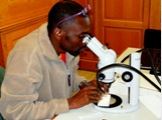 |
Concerning the collection of data on the genus Chalicodoma, species from Burundi, Rwanda and the Democratic Republic of Congo were concerned. The most common species were recorded with the collection locations while for the rare species details such as location, date, sex and collector were noted. The choice of these countries was not the result of chance but was guided by the fact that for the most important zoological collections in the world from Central Africa owned by the MRAC, 80% come from these 3 countries.
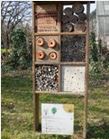 |
From an ecological point of view, a field visit to the botanical garden of the Université Libre de Bruxelles was organized. In this garden, insect hotels are set up in order to protect and preserve pollinators for cultivated species or those in natural environments. It is essentially the Megachiles that are raised. This allowed the improvement of knowledge on the management of pollination by breeding pollinating insects for agro-ecosystems in regions poor in pollinators. |