
Basic Page
Basic Page
Published on
2020 Jan 21Training course on Diplopod Taxonomy at the Royal Museum for Central Africa (MRAC)
 |

|
 |
From 5 to 28 May 2014, Mr. Ntashavu Dieudonné, a student at the Ecole Normale Supérieure (ENS) in Burundi and researcher at the National Institute for Environment and Nature Conservation (INECN) completed a training course at the Royal Museum for Central Africa (MRAC), under the supervision of Dr. Didier Vandenspiegel and under the theme “Systematic and ecological study of diplodes of forest ecosystems” Western Burundi”.
Diplopods are a taxonomic group whose knowledge is still embryonic in Burundi. In fact, the present study is the second after that carried out by Demange in 1977. During it, the species Morphotelus rosseloti and the subspecies Rhapidostreptus innominatus burundiensis were discovered. These samples contain only a very small number of specimens and the stations are not very varied. From 2002 to 2013, Diplopod specimens were collected by Nzigidahera Benoît from ecosystems in western Burundi and preserved in the laboratory of the National Institute for Environment and Nature Conservation (INECN). The objective of this collection was to assess the species richness and the ecological role of Diplopods. Due to the lack of adequate laboratory equipment, a bibliography on Diplopods in Burundi and expertise in the field, the MRAC agreed to support INECN in this research.
From a methodological point of view, the training course on the taxonomy of Diplopods in Burundi was delivered in 2 main moments which are:
- Analysis and taxonomic identification of material in the laboratory;
- Field visit to collect specimens.
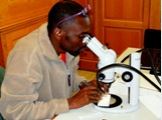 |
Laboratory analysis began with training on the techniques of dissection, isolation and analysis of gonopods (modified legs involved in the transfer of sperm to the female reproductive port), the most used character in Diplopod taxonomy. To do this, the stereomicroscope and the works of the MRAC were used. Training on the study of Diplopods of flattened forms was also carried out in order to separate them according to their families. |
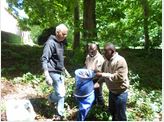 |
During this course, a field visit to acquire techniques for harvesting Diplopods from litter using the Winkler extractor (how to set up the trap and when to trap) was also organized in the MRAC premises. An assembly of the Winkler extractor and a separation of the Diplopods caught in the litter were carried out upon return from the field. | 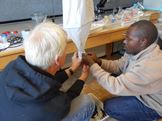 |
The present study provides the first information on the Diplopods of Burundi. Considering that nothing was practically known in Burundi, the training acquired allowed capacity building on techniques for studying Diplopods in the laboratory and in the field. It will also allow for further research on this taxonomic group, which is important in soil fertility as decomposers of organic matter and in bioindication. Until now, knowledge on the fauna of the Diplopods of Burundi has yet to be improved since a large part of the specimens have not been determined to the species. Hence the continuation of their study is of paramount importance. It is therefore urgent to strengthen the framework of collaboration between INECN and the MRAC for the continuation of this research, in particular with the supervision of Burundian technicians in the field.