
Basic Page
Basic Page
Published on
2020 Apr 21Training of trainers workshop for the implementation of the Nagoya Protocol on Access and Fair and Equitable Sharing of Benefits Arising from the Use of Genetic Resources
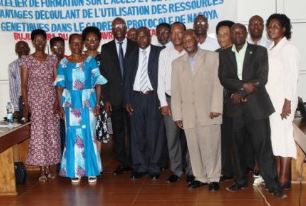
From 11 to 12 April 2016, within the premises of the Star Hotel, a training workshop was held to train trainers for the implementation of the Nagoya Protocol on access and the fair and equitable sharing of benefits arising from the use of genetic resources. This workshop is organized as part of the Project Ratification and Implementation of the Nagoya Protocol on Access to Genetic Resources and the Fair and Equitable Sharing of Benefits arising from their use in the member countries of the Central African Forests Commission (COMIFAC).
|
The workshop was marked by 4 phases, namely:
- Opening ceremonies;
- Session of module presentations, reflections, clarifications and comments;
- Group work;
- Closing ceremonies.
This workshop was opened by an official speech by the Director General of the Burundian Office for Environmental Protection (OBPE). After welcoming the participants, he said that this workshop is therefore a framework to lay the foundations for the implementation of the Nagoya Protocol. Thus, the objectives of this workshop were given, namely:
- Continue to become familiar with the provisions and obligations of the Nagoya Protocol;
- To improve our understanding of the concept of use and the commercial value of genetic resources to different exploitation sectors;
- Improve our understanding of the bases for applying Prior Informed Consent (PIC) in Access for Use processes and indicators of differentiation between requests for access for commercial and non-commercial purposes;
- To improve our knowledge of the relationships between the Nagoya Protocol and the FAO Treaty on Plant Genetic Resources for Food and Agriculture and the importance and modalities of the harmonious implementation of both instruments;
- Learn about the important steps and elements to consider in the process of negotiating Mutually Agreed Agreements and the impact of intellectual property rights issues in APA processes and the negotiation of agreements.
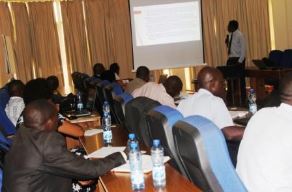 |
The presentation session was opened with a presentation by the APA Focal Point. It was a question of presenting the context, objectives, modules and expected results of the training. He also presented the objective of the Ratification and Implementation of the Nagoya Protocol project on Access to Genetic Resources and the Fair and Equitable Sharing of Benefits arising from their use in COMIFAC member countries, which is to support these countries in ratifying the Nagoya Protocol and starting the implementation of its provisions. |
| After this presentation, the work itself began with the presentations of the modules and exchanges by the expert Dr. Marcelin Tonye Mahop. In total, 5 modules were presented. In each module, the objectives pursued were mentioned and the highlights were developed. | 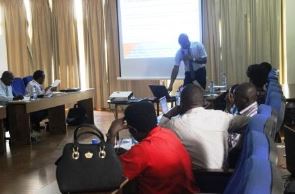 |
The first module consisted of a general understanding of the ABS concept, its fundamental principles and the obligations of the Nagoya Protocol that are incumbent on the parties.
The 2nd module concerned the Use of genetic resources and traditional knowledge, the European approach to implementing the Nagoya Protocol and the importance of ratifying and implementing the Nagoya Protocol.
The theme of the 3rd module was Understanding the links between the Nagoya Protocol and the FAO Treaty on Plant Genetic Resources for Food and Agriculture and Harmonious Implementation.
The 4th module dealt with the negotiations of Mutually Agreed Terms (CCCA): Important Considerations and Impacts of Intellectual Property Rights Issues.
The 5th module concerned the Bases of Application of CPCC and indicators of distinction between Access requests for Non-commercial Use and Commercial Use
Each time, after the presentation of each module, there was a session for reflections, clarifications and comments.
|
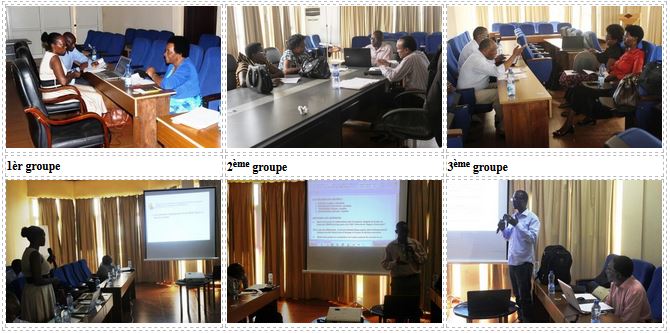
After the presentation of these modules and the rich and varied exchanges that followed, the participants organized themselves into three working groups to analyze relevant issues on ABS. The presentation of this work took place in plenary session.
Restitution of the work of the groups in plenary session.
At the end of this group work, the following recommendations were identified:
- Considering that Burundian regulations on ABS are insufficient, it was recommended that a national law for the implementation of the Nagoya Protocol be rapidly drawn up and that this law should include the principles of intellectual property law;
- Considering that the current measures concern the operator and the government in terms of access, it was recommended to put in place mechanisms to involve all stakeholders, especially local and indigenous communities;
- Taking into account that the level of understanding is still low, it was recommended that an approach be put in place to sensitize all stakeholders;
- In view of the increase in biopiracy, it was recommended to establish a framework for the concerted management of genetic and plant genetic resources;
- Recognizing the relevance of plant genetic resources and the related treaty, it will be necessary to establish a framework for collaboration between all the institutions concerned in order to take concerted decisions;
- It was also recommended to set up a national APA committee to operationalize the Nagoya protocol;
- Considering the pressing need to exchange information on ABS, it was recommended to set up an information exchange center between different actors;
- Participants also recommended the establishment of access approaches in fundamental research;
- Considering the contribution of research to conservation and sustainable use, it was recommended to establish a framework for collaboration between research institutions and environmental protection institutions;
- It was finally recommended to strengthen negotiation capacities in order to take advantage of the benefits in the exploitation of genetic resources.
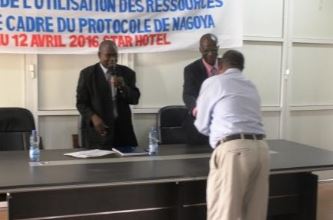 |
The closing ceremonies were enhanced by the Director General of the OBPE. These ceremonies began with the reading of the conclusions and recommendations resulting from this training workshop. Then, they continued with the presentation of certificates of participation in the training by the Director General of OBPE and the APA expert. | 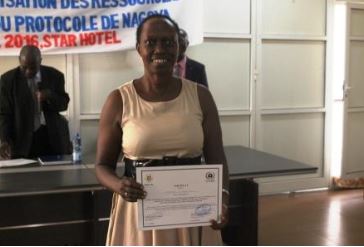 |
In his closing speech, the Director General of OBPE congratulated the participants for the knowledge they had just acquired and called on them to be ambassadors for APA in the various institutions they represent. He ended his speech by expressing his heartfelt thanks to the participants in general and to the APA expert/trainer in particular for the commendable work he had just done.