
Basic Page
Basic Page
Published on
2020 Apr 22Workshop to raise awareness of researchers on the Nagoya Protocol: 2016
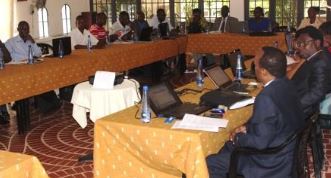 |
On February 17, 2016, in the premises of the Restaurant Chez André, a workshop was held to raise awareness among researchers on the Nagoya Protocol. This workshop was organized as part of the project “Ratification and implementation of the Nagoya Protocol on access to genetic resources and the fair and equitable sharing of benefits arising from their use in member countries of the Central African Forests Commission (COMIFAC)”. |
The work of the workshop was also in line with article 21 of this Protocol relating to raising public awareness on the importance of Genetic Resources and traditional knowledge associated with them and on issues related to Access and Benefit Sharing (ABS) arising from the use of these resources.
The most important moments of this workshop were the following:
- Workshop opening ceremonies;
- Followed by a video on APA;
- Presentation session;
- Exchange session and discussion on presentations;
- Exchanges on questions for committees.
| The opening ceremonies of the workshop were dominated by an opening speech delivered by the Permanent Secretary who represented the Minister of Water, Environment, Land Use Planning and Urban Development (MEEATU) prevented. In his speech, he recalled that beginning in the 1980s, several industrial sectors developed a contested practice consisting in collecting the planet's natural resources and traditional knowledge about their proper use, in order to exploit them commercially. | 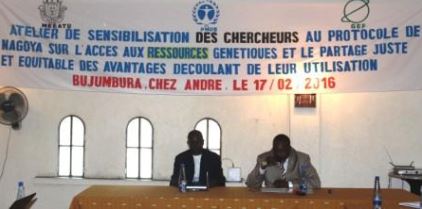 |
These operations, conducted without prior authorization from the national authorities and without compensation mechanisms in favor of local populations, essentially constitute a transfer of wealth from the South (reservoir of most of the world's biodiversity) to the North, without monetary or non-monetary compensation. He continued his speech by talking about the Nagoya Protocol and its goals, which were summed up in an ambition to end this unfair practice of exploiting genetic resources and associated knowledge without authorization or monetary compensation or not from the holders of these resources or knowledge. He went on to say that the Protocol is an international tool designed to regulate the transfer of technology and indigenous genetic resources from supplier countries (holders) and user countries (operators). This is because the secretariat of the Convention on Biological Diversity (CBD) does not have any coercive means and the international community is not ready to work in line on this issue, the Nagoya Protocol is the only international instrument that makes it possible to act against “biopiracy”. He ended his speech by thanking the Global Environment Facility (GEF) and the United Nations Environment Programme (UNEP) for their financial and technical support and invited participants to immerse themselves in ABS issues and contribute actively and effectively to the implementation of the Protocol.
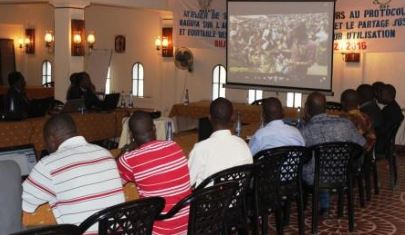 |
After the opening ceremonies, participants watched a video on APA. The video was about the origins of the Nagoya Protocol and some cases of ABS that are already known in Africa. The video screening was followed by 3 presentations which are: | 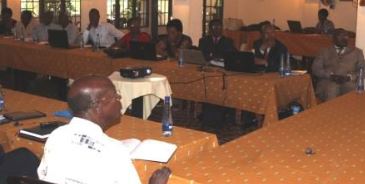 |
The Nagoya Protocol on Access and the Fair and Equitable Sharing of Benefits Arising from the Use of Genetic Resources: An Overview;
- Access and the fair and equitable sharing of benefits arising from the use of medicinal genetic resources: An appeal to traditional practitioners in Burundi;
- Presentation on accessing and sharing the benefits of using genetic resources: A special message to researchers.
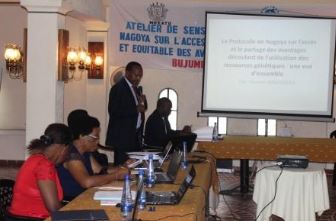 |
Mr. Nindorera Damien, legal advisor at OBPE These operations, he continued, conducted without prior authorization from the national authorities and without compensation mechanisms in favor of local populations, gave rise to biopiracy. |
This is how, he added, the international community decided to combat this biopiracy through an international legal framework, hence the birth of the Nagoya Protocol linked to the Convention on Biological Diversity through one of its three objectives talking about the fair and equitable sharing of benefits arising from the use of biological resources. He continued his presentation by talking about the concepts of rules and clear procedures for Prior Informed Consent (PIC), which is an authorization given to a user by the competent national authorities of a supplier country before accessing genetic resources, in accordance with an appropriate legal and institutional framework as well as the clear rules and procedures on Mutually Agreed Conditions (CCCA). These constitute an agreement, reached by mutual agreement between providers of genetic resources and users, governing the conditions of access and use of resources, as well as the sharing of benefits between the two parties.
| Madame Marie Josée Bigendako professor at the University of Burundi. He | 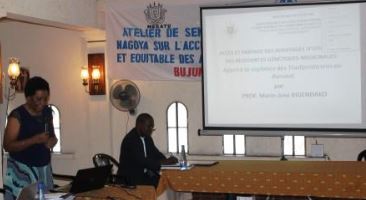 |
The participants were also briefed on the prerequisites for implementing the Nagoya Protocol in traditional medication. The speaker ended her presentation by talking about priority actions for this implementation.
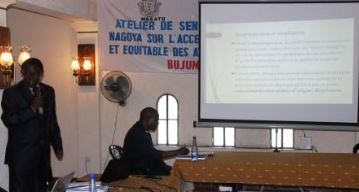 |
Mr. Nzigidahera Benoit at the same time the National Focal Point of the Nagoya Protocol |
As for Biopiracy, this means that the products mentioned above, when they prove to be interesting and accepted according to the required standards, are patented in the name of the legal or natural person who developed them, without compensation to the country of origin. With regard to the scope of application of the Protocol, he said that it applied to genetic resources (the genetic and/or biochemical composition of animals, plants, microbes and others for research and development purposes), to traditional knowledge associated with genetic resources, and to the benefits arising from their use. He also talked about non-applicable fields, which are the field of human genetic resources, genetic resources over which states do not exercise sovereign rights, genetic resources covered by sectoral ABS instruments (in particular those used for agriculture and food under FAO) and genetic resources used as raw materials for agricultural and food purposes (without research and development activities). He ended his presentation by talking about ABS obligations, which are access obligations, benefit-sharing obligations, and compliance obligations. The presentation session was followed by an opportunity for participants to comment, ask questions, and contribute. Whenever needed, presenters provided answers to participants' questions and concerns.

|
After the discussion session, participants observed a moment of discussion on four questions intended for committee work and the work of the workshop ended with a word of thanks delivered by the National Focal Point of the Nagoya Protocol at 15:30pm Bujumbura time.