Document
Document
File Name
lexique kdi_poissons.pdfFile Type
PDF DocumentFile Size
762 kBCreated Date
2019 Dec 28Updated Date
2019 Dec 28Published on
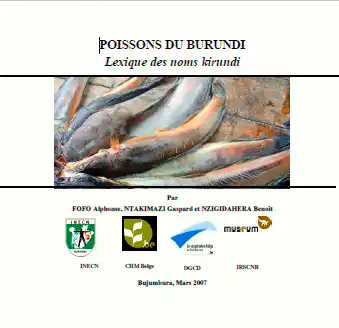
2007 Mar 01Burundian fish: Lexicon of Kirundi names
This lexicon was developed on the basis of data collected here and there in existing documents and through surveys and direct observations carried out in the field. This document shows that local communities have long shown particular importance to nature, mainly biodiversity, whose fairly profound traditional knowledge has allowed them to name and differentiate almost all the fish they used to see, handle and consume.
The production of this document was motivated by the urgent need to give more opportunities to the Burundian population, especially young people, to know the species that they often see, that they have not yet seen or that they will certainly not see as a result of the various factors responsible for the disappearance of part of the ichthyofauna, both lake and river.
This document is undoubtedly the first lexicon of Kirundi names resulting from the compilation of data collected either in the field or in various research studies carried out at the National Institute for the Environment and Nature Conservation and at the University of Burundi.
A close analysis of this lexicon shows that the Kirundi names given to certain species prove that Burundians have long had virtually exceptional technical observation skills, allowing them to group fish according to their distinctive morphological and physiognomic characters.
In fact, all species in families such as Mochocidae, Clariidae, Mormyridae, Mastacambelidae, etc. have Kirundi names respectively Akangohongoho, Isomvyi or Ikambare, Ikiragi, Umurombo. It is very impressive to note that Burundians have tried to differentiate the different species of Cichlidae, a very rich family whose species is still not easy to determine. It will thus be noted that “Impeka” includes all the species of the genus Tropheus, “Igipopo” for the genus Xenotilapia and Igifyunu for Bagrus docmac.
Depending on the different regions of the country, it should be noted that a single species may have more than one denomination. This does not facilitate the use of this lexicon in the identification of certain species. It becomes even more complicated if a name is given to different species that do not often belong to the same family. This is the case of “Ingege” for Barbus toppini from the Cyprinidae family and for Oreochromis niloticus from the Cichlidae family.