Document
Document
File Name
Politique d'élevage au Burundi_avril 2017 f.docFile Type
Word DocumentFile Size
148 kBCreated Date
2021 Jul 26Updated Date
2021 Jul 26Published on
2017 Jul 04NATIONAL LIVESTOCK POLICY IN BURUNDI
The Ministry of the Environment, Agriculture and Livestock has the National Agricultural Strategy from 2016 to 2020 and the National Agricultural Investment Plan 2016-2017 which are aimed at agriculture as well as livestock. Given the importance of the livestock sector in Burundi, the definition of a sectoral policy relating to this sector would promote the development of this sector.
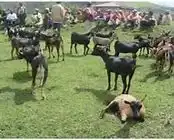
According to official figures from the General Directorate of Livestock (DGE) in 2016, the country had around 623.031 cattle, 1,821,626 goats, 229,279 sheep, 333,925 pigs, 1,591,925 pigs, 1,591,273 pigs, 1,591,273 hens and 245,369 rabbits.
Estimated more realistically on the basis of these numbers, and considering not global average productivities by species but the specific individual productivities of each farming system practiced, national productions would more than likely be around 22,000 tons of meat and 70 million liters of milk. The country would also produce 16 million eggs and more than one million tons of manure allowing the fertilization of 10% of cultivated food areas. (DOS Breeding)
Taking into account these productions and the Added Values (VA) of the post-production stage and manure, the Value Added of Livestock (VAE) is approximately 14% of the national GDP and 29% of the agricultural GDP.
A real safety net for poor households, it also constitutes savings paid for by the gross growth rate of livestock. During the recent price surge crisis, extensive livestock farming allowed many households to withstand fluctuations in food prices thanks to manure. It offers households an opportunity to add value to crop residues and kitchen waste. Through fodder crops, it plays an important role against erosion and the improvement of nitrogen fixation in soils (DOS Livage).
According to the ISTEEBU 2014-2015 National Survey report, 20% of agricultural households own cattle, 42% own goats, 11% own sheep, 20% own pigs, 6% own rabbits, 6% own rabbits while 30% own poultry.
However, the livestock sector is however insufficiently productive to meet consumer demand and even less to cover the population's animal protein needs: a large proportion of the country's meat consumption and milk consumption are provided by imports. In fact, around 20% of meat consumption and 5% of milk consumption in the country are provided by imports.
Also, the livestock sector is facing health constraints, including repeated epidemics, which cause cases of animal mortality, which is detrimental to livestock production and productivity.