Document
Document
File Name
lex-web-version.pdfFile Type
PDF DocumentFile Size
5.13 MBCreated Date
2019 Dec 05Updated Date
2019 Dec 05Published on
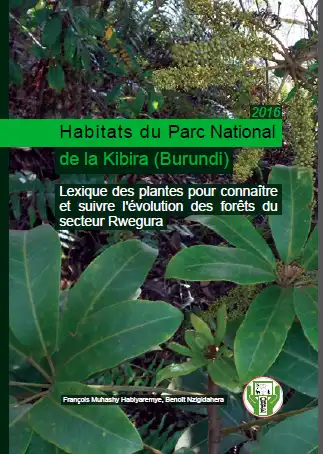
2016 Jan 01Plant lexicon to know and follow the evolution of forests in the Rwegura sector
This guide on flora for monitoring the dynamics of the habitats of the Kibira National Park was developed as part of the Research Program, Information Exchange, Awareness and Conservation of Biodiversity in Burundi, set up under a partnership between the Burundian Office for Environmental Protection (OBPE) (ex INECN) and the Royal Institute of Natural Sciences of Belgium (IRSNB). Through this program, the research component aims, among other things, “The consolidation of biodiversity monitoring mechanisms”.
The development of this manual contributes to the strengthening of the capacities of OBPE staff in protected areas to monitor the dynamics of habitats in order to improve the management of biodiversity. To facilitate this work, an ecological trail has been drawn at the level of each sector of the country's three main PAs. The mission carried out jointly by the IRSNB and the OBPE in 2011 in the PNKi, at the level of the Rwegura sector, was used to gather elements that constitute an important part of the content of this publication and to prepare the workshop held there in 2012 as a training course in collecting data on the evolution of habitats.
As part of the synergies with the University of Burundi (UB), a reference study was subsequently conducted along the ecological trail established in the Rwegura sector. The training courses organized in workshops made it possible to launch:
• The establishment of a functional system for collecting data on habitat types and their evolution;
• Recognition of dominant plants which, as such, serve as a reference for the recognition of habitats; Preface iv
• The establishment and updating of a database and feeding it with contributions provided on habitats by field staff. This guide is therefore another step taken in the process of setting up tools for monitoring the dynamics of habitats in (PNKi).
It presents the various habitats that make up the park and plant species encountered along the observation routes. These are the dominant plant species, which constitute references for the recognition of the types of habitats in which they are found. This guide also includes a list of the Latin names of all the species collected in this park and their Kirundi names.
This book is a didactic tool whose merit is to easily make the vegetation of the Rwegura sector (PNKi) known easily not only to people who directly monitor the biodiversity of protected areas, but also to all those who wish to know the flora of the park, especially students, researchers and tourists.
I would like to thank the Royal Institute of Natural Sciences of Belgium and the Directorate-General for Belgian Development Cooperation for the scientific, technical and financial support shown in supporting Burundi in the conservation of biodiversity. My thanks also go to the supervisors of the reference studies for monitoring the dynamics of habitats in protected areas and to the authors of this guide.