Document
Document
File Name
pap-pnd-bi.pdfFile Type
PDF DocumentFile Size
1.53 MBCreated Date
2020 May 22Updated Date
2020 May 22Published on
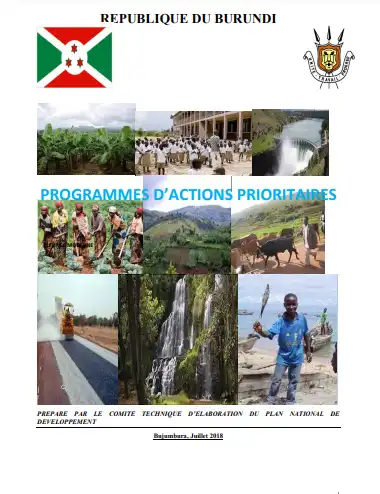
2019 Jul 01Priority action programmes prepared by the technical committee for the preparation of the national development plan
This program of priority actions is a response to the challenges of economic and social development in Burundi. It translates the guidelines of the National Development Plan (PND Burundi 2018-2027) into strategic objectives broken down into programs aimed at the structural transformation of the economy for sustained, inclusive and sustainable growth on the one hand, and on the other hand, the consolidation of the achievements of peace, good governance, without forgetting the development of human capital in general and demographic dividends in particular.
The development of this programme of priority actions is guided by the need to strengthen the coherence of sectoral policies with the National Development Plan and, above all, to seek a better impact of these programmes and projects on the economic and social development of Burundi. At the level of methodology, the process of developing this Programme of Priority Actions followed a participatory, inclusive and iterative approach involving representatives of institutions and technical ministries. The Government will implement it through Sectoral Action Plans that will be reviewed every three years, in order to take into account the lessons of implementation and the deepening of sectoral policies and strategies.
The content of this Priority Action Programme covers 16 areas of intervention on which the economic and social development of Burundi is based. These are: (i) agriculture, livestock and food security, (ii) infrastructure development (energy, transport, information and communication technologies and the media), (iii) mining, industrial and artisanal sector, (iv) improvement of performance and collaboration in the field of health, (v) improvement of performance and collaboration in the field of health, (v) strengthening of the education system and improvement of training provision, (vi) development of the social protection sector, (vii) decent employment and youth, (viii) demographic dividend, (ix) sustainable environmental management, (x) water resource and global sanitation, (xi) climate change and risk management, (xii) climate change and risk management, (xii) land use planning, (xiii) governance, (xiv) national security and defense, (XV) resource mobilization, (164) development of sub-regional, regional and international cooperation and partnerships. Each axis of intervention is divided into main strategic objectives, priority programs and projects for their implementation.
Some of the priority programs chosen are multisectoral, in particular those relating to governance, the fight against malnutrition, the fight against malnutrition, the promotion of human rights, the eradication of inequalities in all their forms, the promotion of public-private partnerships, the strengthening of institutional capacities and/or the management of the economy, the strengthening of institutional capacities and/or the management of the economy, resilience to climate change and environmental protection, decentralization, mobilization of resources, etc. The preferred approach for the implementation of the programmes multisectoral requires, on the one hand, the development of synergies and the complementarity of projects and, on the other hand, a good measurement of the effects and impacts on the progress achieved by the country towards emergence. The PAP also integrates the macroeconomic framework that indicates trends in the growth of national production by sector (primary, secondary and tertiary) together with a fiscal framework and also includes the levers for structural transformation of the economy, the structural reforms to be initiated, the mechanism for financing the PAP as well as the mechanism for monitoring and evaluating its implementation.
The PAP expenditure forecasts for the period 2018-2027 were developed with a high priority given to growth-generating sectors and basic social sectors. Agriculture, livestock and food security, infrastructure development (energy, mines, mines, drinking water, transport, ICT.), the industrial, mining and tourism sector, the buildings and urban planning sector as well as land use planning maintain a prominent place in the distribution of budgetary expenditures. The sectors in charge of governance issues, in particular the judiciary and State audit institutions, also benefit from a larger budget, reflecting the Government's desire to strengthen the rule of law and develop transparent mechanisms in the management of public finances.