Document
Document
File Name
pag-parc-national-ruvubu.pdfFile Type
PDF DocumentFile Size
2.28 MBCreated Date
2020 Apr 13Updated Date
2020 Apr 13Published on
2014 Nov 01Ruvubu National Park Development and Management Plan
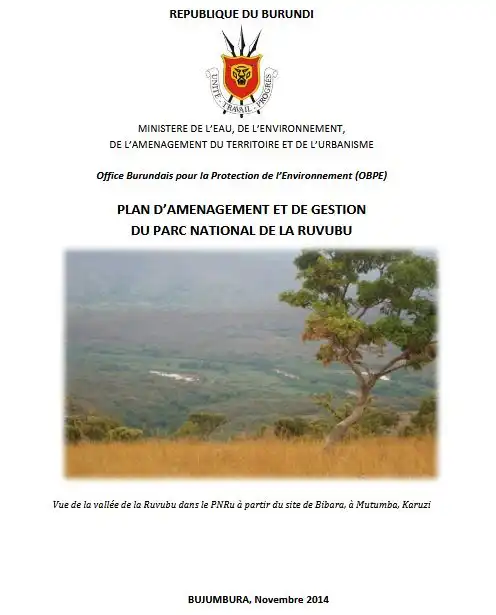
The pNRU represents a natural ecological system of medium altitude, made up of more than 80% of different types of savannah (wooded, shrubby, tree-like and grassy savannas), to which are added forest galleries along the Ruvubu and its tributaries, marshes in the lowlands and flooded/flooded flats and some shreds of open forest. The characteristic woody species of the savannah part are Parinari curatellifolia (umunazi), Pericopsis angolensis (umukambati) and Hymenocardia acida (umusagamba), while the swamps, which are also very visible, are mainly populated by Cyperus latifolius (urukangaga) and Cyperus papyrus (urufunzo). This park represents the only national area where the large mammalian fauna is still palpable by its populations of hippopotamus (Hippopotamus amphibius), buffalo (Syncerus caffer), waterbucks (Kobus ellipsiprymnus), harnessed guibs (Tragelaphus scriptus), baboons (Papio anubis) and many other species. Ruvubu, which gave its name to the whole of AP, is also inhabited by Crocodylus niloticus, the impressive crocodile of the Nile.
Since October 2014, the planning and management body of the PNru has been the OBPE, which at its creation was called INCN, set up by Decree-Law No. 100/147 of 3 March 1980. The latter was reorganized into INECN, 9 years later, by Decree-Law No. 100/188 of 5 October 1989. Today, the PNru is mainly governed by:
- Decree No. 100/113 of 12 April 2011 delimiting the Ruvubu National Park and
- Decree No. 1/10 of 30 May 2011 establishing and managing protected areas in Burundi.
Despite the national and regional importance of the PNru, it must be noted that it suffers a lot of nuisances that greatly hamper its normal development. The most serious of these harmful effects are repeated bushfires and poaching in its various forms. After that comes the cohort of the presence of bandits (armed or unarmed), agricultural encroachment, the search for medicinal plants, the collection of plant and wild animal food resources, the collection of wild plant and animal food resources, the collection of wild plant and animal food resources, the extraction of clay, the grazing of cows, etc. For the effective conservation of Burundi's largest park and its sustainable management, this PAG, which will be the first to be developed and implemented for PNru, proposes a restructuring of the park management authority, in particular by innovating 4 positions of Deputy Curators, placed under the hierarchical authority of the Chief Curator. The PAG is planned for a period of 5 years and presents a layout of the site in 4 types of zones: integral areas, tourist areas, cooperation areas and areas for the recovery of natural vegetation. The management program has 5 fundamental sub-programs that relate to the following 5 areas:
- protection and surveillance,
- community participation,
- ecotourism,
- research and monitoring,
- veterinary service.