Document
Document
File Name
pag-reserv-naturel-vyanda.pdfFile Type
PDF DocumentFile Size
1.95 MBCreated Date
2020 Apr 13Updated Date
2020 Apr 13Published on
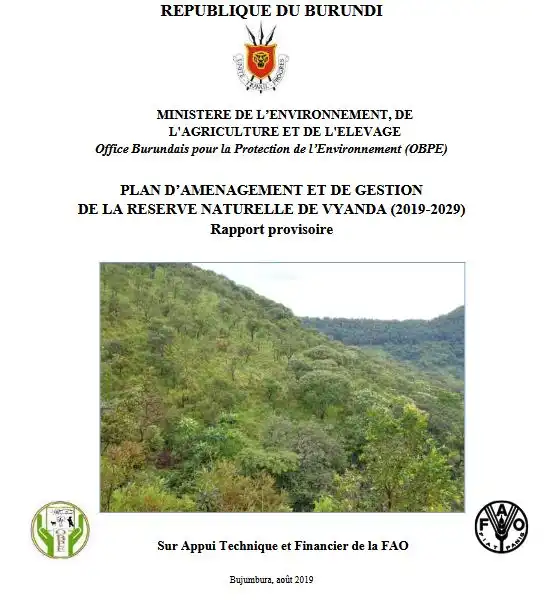
2019 Aug 01Vyanda Nature Reserve Development and Management Plan (2019-2029)
The development and management plan is a framework document guiding the management of natural sites based on the challenges and management objectives agreed upon by the various actors. It is an essential tool to allow the curator to always know what to do at the given moment (IUCN, 2012)
To be effective, the management plan is developed in a participatory process. The law on protected areas in Burundi, adopted in 2011, states that each protected area must have a development and management plan developed through a participatory process.
For this reason, the development of this PAG, which focuses on the identification and prioritization of the present heritage, on the evaluation of the functionality of the ecosystem and on the analysis of the socio-economic context, was written over a period of 9 months (slightly less than the ideal period of one year) in order to allow the collection of ideas from a large number of stakeholders.
It is based on the data available at the time of writing, summarizes and evaluates it in order to identify the challenges of space in terms of nature conservation. It collects a certain amount of data that is not available and orients the missing data. It values local (or vernacular) knowledge, by carrying out the diagnosis with rigor and transparency and by presenting the results and the various stages of the implementation of the management plan in a way that the actors can understand.
This rigorous and shared diagnosis serves as the basis for formulating the ideal state of the protected area (long-term goals). Its long-term goals can often not be achieved over the duration of the management plan due to various factors. Thus, the activities proposed will finally contribute to an attempt to act on these factors, through the objectives of the management plan (= objectives that have the lifespan of the plan), which are themselves broken down into operations, in order to gradually move towards the long-term objectives.