News
News
Published on
2020 Oct 06Lake level remains high despite the end of the dry season
The water level in Lake Tanganyika remains high. At the end of the dry season, the water level should have dropped more and the waters should have receded more to return to their usual beds. Residents live with fear in their stomachs. In this issue, we look back at the situation and possible solutions to protect shoreline infrastructures.
We are at the end of the dry season and yet the waters of the lake have not returned to their level of last year, in August 2019. It is on the beach of the Safari Gate Hotel, on the terrace called Les Paillotes, that we tried to assess the water level. According to our observations there, the water level has dropped by about 40 cm compared to the end of May last year. This is not much, because usually, during the three months of dry season and evaporation, the waters recede by 80 cm to one meter on average. We can therefore be surprised or even worried. Has the lake been in an upward phase for 2 to 3 years as Burundi Eco recalled in several articles? It is difficult to answer this question because, to date, we have not been able to find the graph of lake levels for the last 3 years. It is curious to note that no public authority systematically publishes the lake's water level. Faced with this deficit of public information making it difficult to observe the phenomenon, Burundi Eco is appealing to the authorities and to anyone who may have this data.
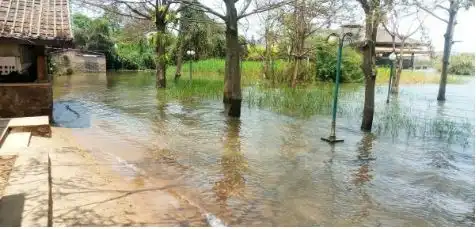
But let us return to our observations of the present situation. A Burundi Eco reporter went to the shores of the lake in Bujumbura on Monday, September 14. During the visit he made to the coast. Some beaches are still invaded by water. Others are inaccessible. Examples include Lacosta Beach, Saga Vodo, Zion Beach, Zion Beach, Safari Gate, Safi Beach, etc. Quite a few infrastructures are still under water. There are only sentries there. The owners of the houses have emptied the premises. In the Kinindo West district on Ruhuhuma, Ntwarante, Ntwarante, Ndamukiza, Ndamukiza, Rusama and Beraka Avenues, the waters of the lake have receded a bit but still remain in many places. the local population lives in fear because the waters of this freshwater reservoir can rise to an appalling level at any time. This ordeal pushes her to think about adapting to this persistent flood.
Strategies to prevent lake waters from flooding Nzero Avenue
Those who use Nzero Avenue located in the Kinindo West district of Muha commune are in the process of raising the height of this avenue, which was impassable in recent months, until May. We put sand all along this avenue to raise it up. This work was initiated in order to prevent the waters of the lake from flooding this avenue in order to make it accessible. But while the path may have been preserved, this will not be the case for the houses that border it. Residents who spoke to Burundi Eco also say that there are new strategies adopted to build houses there. Currently, the height of the foundations is raised to a significant level to prevent water from entering the interior of the houses. In recent months, some waterfront infrastructures have been flooded. For example, these are “Paradise appartments hotel” located at Nzero Avenue in the West Kinindo district. According to testimonies collected there, this hotel was almost closed in recent weeks due to the arrival of water on its ground floor.
At the Safari Gate hotel restaurant called Les Paillottes, the water has receded, freeing one meter on the ground, the level seems to have dropped by 40 cm. However, some huts and the toilets in this restaurant are still under water. The servers encountered there say that the rising waters have disrupted their economic activities. The manager of this restaurant fears that the upcoming rainy season will again create a flood of kitchens. This infrastructure may still remain under water.
At Safi Beach, it can also be seen that the waters have dropped somewhat, freeing up one meter of sandy beach. In recent months, its owner was in a state of desolation due to rising waters, which meant that he was working at a loss. Activities have been paralyzed, as 90% of this beach has been invaded by lake waters. He is afraid of finding himself in the same predicament, as the rainy season is on the way.
In Gatumba, the Mushasa I and II districts still under water
In the Gatumba Zone, a Mutimbuzi commune in Bujumbura province, stagnant water is mainly observed in the Mushasa I and II neighborhoods as well as Gaharawe. However, there is currently no standing water in the districts Kinyinya I and II, Muyange I and II, Warubondo as well as Vugizo. For this reason, the government has decided to permanently relocate residents from neighborhoods where stagnant water is still observed.
Respect for the buffer zone, an effective solution
Albert Mbonerane, a friend of nature and expert on the lake and environmental protection regulations, asks the population to respect the 150 m buffer zone, because those affected by the rise in the lake's waters are people who built or cultivated in this buffer zone by stepping on the Water Code. He specifies that the establishment of new neighborhoods must be preceded by feasibility studies carried out by the OBUHA in order not to be exposed to potential risks. The boundaries of the lake have not always been the same as they are today. Those who lived in Bujumbura some thirty years ago know this. History tells us that the waters of Lake Tanganyika have never been stable. Periods of heavy rains causing the lake's waters to rise have been legion for a long time. Around the years 1963, Mbonerane pointed out that the waters of the lake rose to where the infrastructures of the National Radio Television of Burundi (RTNB) were built.
To avoid disaster for the residents of this lake, the government did not let its guard down. He put in place the Water Code and other texts whose objective was to safeguard the environment. Article 5 of the Water Code states that it is forbidden to build within 150 m from the highest flood level of Lake Tanganyika. For its tributaries, 25 m must be respected, for northern lakes 50 m and 5 m for rivers in the interior of the country. However, now people are constantly taking over the buffer zone along the entire coastline of the lake to build luxurious villas. In July 2011, the Burundian parliament addressed the issue of the lawless buildings erected on the shores of Lake Tanganyika. Field visits have increased to inquire about the situation. Nevertheless, houses have never stopped growing there like mushrooms in contradiction with legislation and regulations. Many observers question the inaction of the urban planning services and the complacency of the public authorities responsible for applying and complying with building laws.