
News
News

Published on
2020 Feb 14Workshop to raise awareness among local and administrative communities on the socio-economic importance of the species Ermospatha haullevilleana (Rattan) for its effective restoration
On January 27 to 28, 2020, a workshop was held in the Kigwena zone of Rumonge municipality and Rumonge province, a workshop on raising the awareness of local and administrative communities on the socio-economic importance of the species Ermospatha haullevilleana (Rattan) for its effective restoration and this as part of the research program, information exchange, awareness and conservation of biodiversity.
Were present:
The Representative of the Director General of the Burundian Office for Environmental Protection (OBPE), a Representative of the Governor of Rumonge Province, the various heads of riparian areas of the Kigwena Forest Reserve, the manager of the Kigwena Forest Reserve, the manager of the Kigwena Forest Reserve, the various executives of the OBPE, the various managers of the OBPE, the managers of environmental clubs in the zone and the students who are members of these clubs, the operators of Eremospe Atha in the region, the Provincial Commissioner for Civil Protection, the members of various associations working in the field of the environment, the head of the Provincial Office for Environment, Agriculture and Livestock (BPEAE) and the representative of the local radio IZERE FM.
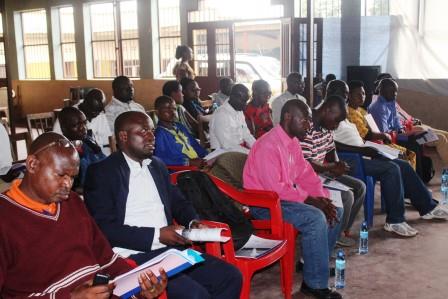
|
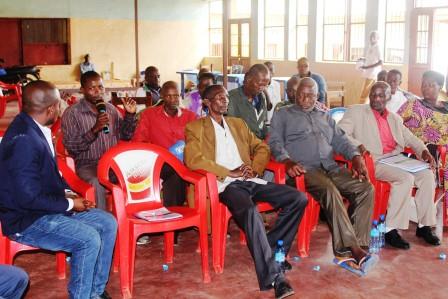
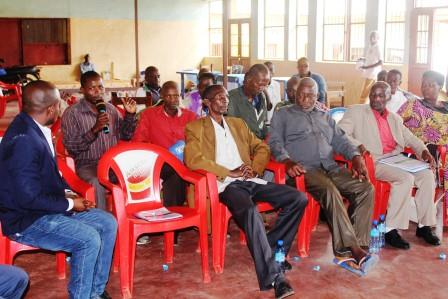
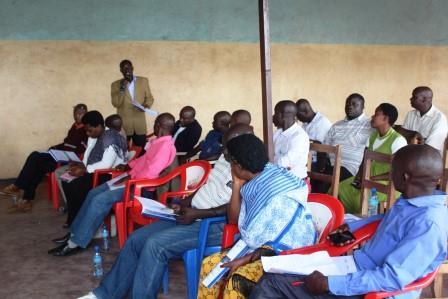
| Participant in the Eremospatha workshop |
After the presentation of the participants, the presentation on the species Eremospatha haullevilleana (Rattan) and its socio-economic issues followed.
Presentation on the state of play of Eremospatha haullevilleana
The presentation on this species was made by Mr Onesphore MASABO and focused on the theme: “Understanding the socio-economic importance of rattan for its effective restoration: Appeal to stakeholders including local communities and administrative officials at the base for their effective involvement in the restoration of rattan in Burundi”.
|
At the beginning of this presentation, it was reported that several actors are unaware of the importance of different natural resources in general and the Eremospatha species in particular. Thus for the latter, it is threatened with extinction.
Indeed, demographic pressure and the scarcity of land in Burundi are the main sources of the extinction of Eremospatha. These two factors lead to the conversion of natural ecosystems in general and the habitats of Eremospatha in particular, into agricultural land. |
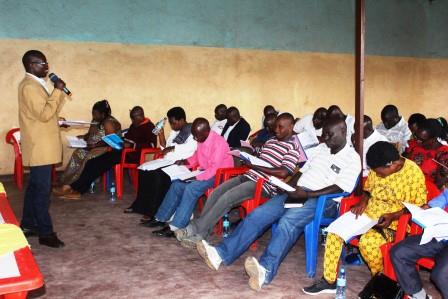 |
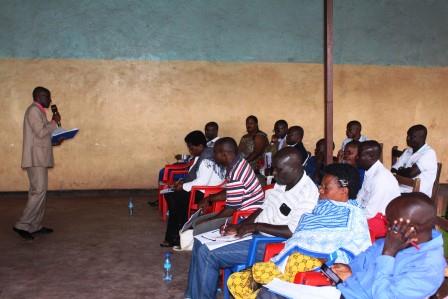
| Presentation on Eremopatha by Mr MASABO Onesphore |
The current situation of Eremospatha is very critical despite its multiple uses of socio-economic importance. With regard to its uses, the presenter emphasized that the species had been used in Burundi for a very long time. For example, in royal times the stretchers used to transport the king were made of rattan. Also, various materials such as beds and furniture were made of rattan. Currently, furniture made from Eremospatha is considered to be of high quality and, moreover, it costs more than furniture made of wood. This species is of high economic value, which has even been testified by its former operators in the region. They said that in 1980, 1 kg of rattan was purchased by the Chinese at prices varying between 200 and 300 fBu. According to these operators, they could easily earn 100,000 fBu per week. They added that some people bought land and vehicles with money from this business. These prices compared to the current price of coffee (500 Fbu per kg), a cash crop in Burundi, attest to the high economic value of Eremospatha.
From the point of view of distribution of the species, the study which was conducted in 201... revealed that the species is currently found in some provinces of Burundi but in the form of traces. This is justified by an area occupied by the species that does not exceed 1 ha throughout Burundian territory.
Faced with this situation, planning, which is currently insufficient, for the management of this species is essential. And referring to article 28 of law no. 1/10 of 30 May 2011 on the creation and management of protected areas in Burundi, which states that if a renewable resource in a protected area is in danger, known or foreseeable in an impact study, alternatives may be considered for local populations. Thus, innovative alternatives must be adopted to restore Eremospatha in a context of demographic pressure and land scarcity. One of the innovative techniques proposed by the OBPE is the association of Eremospatha with oil palm trees.
It is in this context that the OPBE has undertaken studies on Eremospatha on its distribution and domestication with a view to its restoration. The results of the study on the domestication of the species were promising. In fact, the study consisted of the association of Eremospatha and oil palm trees. This combination has proved to be the most beneficial since it involves the introduction of Eremospatha into oil palm fields at the stage where association with other plants is no longer possible. Also, the space occupied by these two species would be sustainably valued, which would therefore make it possible to have a double yield.
The presenter landed by explaining that the success of restoration through this association of these two species requires the collaboration of all actors including administrative officials, local communities, agricultural technicians and research institutions. Local communities that own palm oil fields should be sensitized in order to adopt this technique. This requires the strong involvement of grassroots administrators and agricultural technicians, but also associations and environmental clubs from the various schools in the area.
Once the community is aware of the importance of the Eremosptha and Oil Palm association, their structuring in association is imperative.
That their supervision would be essential for the system to be very productive but also its operation should be regulated.
That the OBPE should strengthen awareness among the various actors who have an impact on the sustainable management of the Eremospatha species and its association with oil palms so that these actors take ownership of it.
After the presentation, the various participants spoke about the species Eremospatha and its association with oil palm.
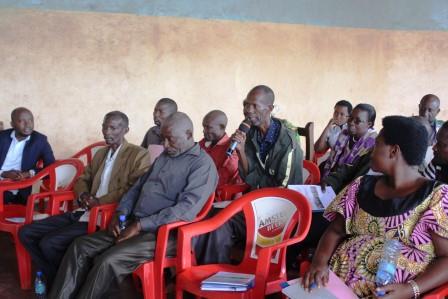
Through the various interventions of the participants, technical and socio-economic aspects around the species were debated. Some questions and comments were raised, among others:
- In the event of an association of these two species there would be no competition between them, which would reduce the yield of one of the two but especially that of the oil palm.
- Would it be easy to harvest the fruits of the oil palm once Eremospatha, thorny plants, had reached the height of the palm tree
- The market for Eremospatha would be guaranteed once the population adopted this system of combining Eremospatha and Oil Palm.
- What about the time allowed to be able to harvest Eremospatha.
- Is the OBPE considering techniques for multiplying Eremopatha and what about their popularization.
- Would the OBPE have consulted the OHP protocol for oil palm in order to take it into account by proposing the association of the latter with Eremospatha
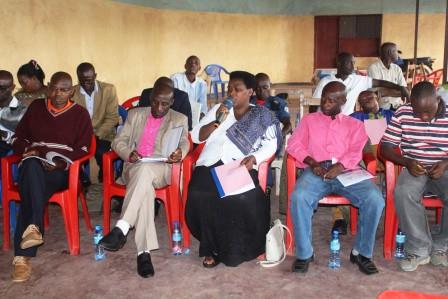 |
|
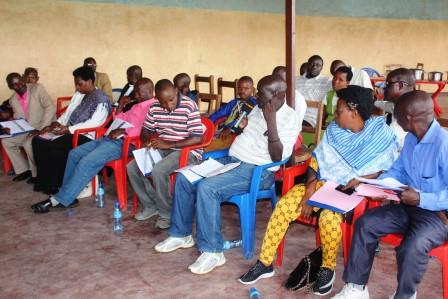 |
 |
 |
 |
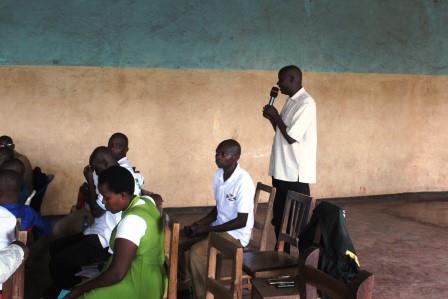
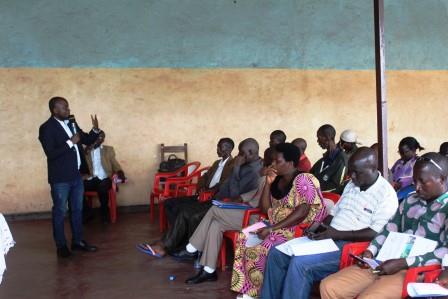
Different interventions by workshop participants
In relation to the probable competition between Eremospatha and oil palm once combined, the OBPE executives confirmed that although this aspect is not yet well studied, the results of the previous study on the association of these two species were promising. But future studies could compare oil palm yields in combination with Eremospatha to oil palm yields in monoculture.
According to OBPE officials, the species is currently exported from Tanzania by the owners of workshops who use it as a raw material in the manufacture of real estate, which justifies that the sales market is guaranteed.
In relation to the control of the life cycle of Eremospatha, the OBPE executives replied that this aspect has not yet been studied but it is envisaged to carry it out in the near future.
Concerning the mastery of Eremospatha multiplication techniques, the OBPE plans to popularize these techniques among agricultural technicians and local communities. The OBPE also intends to collaborate with other research institutions (ISABU, University of Burundi,...) to study more efficient multiplication techniques for the species.
 |
 |
 |
Before closing the meeting, various recommendations were made, namely:
- Conduct studies on the yields of oil palm trees in case of their association with Eremospatha in order to assess the probable competition for nutrients between these 2 species;
- To study and control the life cycle of Eremospatha in order to assess the profitability its association with oil palm would be profitable;
- Establish, in collaboration with OHP, a protocol for the production and exploitation of Ermospatha in association with the oil palm;
- This protocol must also be translated into the national language in order for it to be operational at all levels;
- Set up a nursery that will be used for the multiplication of Eremospatha among local communities;
- Strengthen awareness so that all actors understand the advantages of combining these two species
- Implement legal texts aimed at the preservation of endangered species in order to sustainably manage the Eremospatha stock remaining in Burundi.
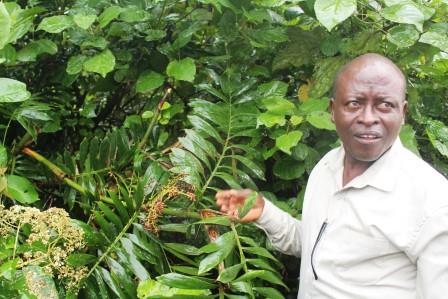
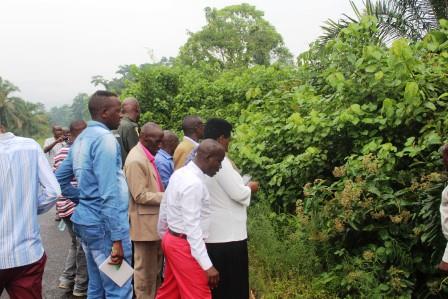
After the classroom session, a guided field visit followed. Guided by the manager of the Kigwena Forest Reserve and the executives at OBPE, the visit was carried out in a habitat in the reserve where Eremospatha proliferates. The aim of this visit was to make observations in situ since the various participants declared that they did not know this species.
 |
 |
