Protected Area
Protected Area
Published on
2020 Apr 01Rusizi National Park
The Rusizi National Park has a complex history that has regularly changed its name. Indeed, called a Nature Reserve with approximately 8,000 ha at its creation in 1980, it received the name of National Park in 1990 with 12350 ha to once again return to the name of Reserve with the decree of 2000 which reduced almost half of its area.
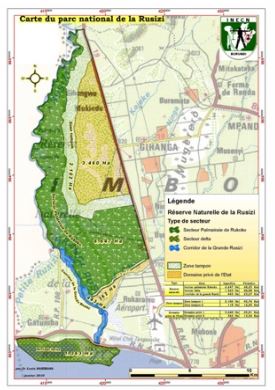 |
By revision of this decree of 2000, the area became a National Park again with 10673 ha with the promulgation of the decree of 2011 which revised the limits of this park. The name change has affected how it is managed, but the site has regularly been an interesting case study for the participatory management of protected areas in Burundi. The Rusizi National Park is located in the Rusizi Plain, north of the Imbo and Lake Tanganyika Natural Region. The Rusizi plain is shared between the Democratic Republic of Congo (DRC), Rwanda and Burundi and covers an area of about 3000 km2 including 1750 km2 for Burundi. It is part of the system of great African rifts and occupies, like Lake Tanganyika, the central sector of Western Graben. It is bordered by spectacular escarpments both to the West and to the East. This park, which owes its name to the Rusizi River, which itself originates in Lake Kivu, is subdivided into two sectors: |
The average altitude is 775 m at the level of the delta of the Rusizi River which flows into Lake Tanganyika. The vegetation of the Palm Grove Sector includes more than 1000 different plant species. In this park, there are 4 distinct plant formations:
- Hyphaene benguellensis var. ventricosa formations occupying some 1,200 ha, confined along the Rusizi River. It is an endemic subspecies for the region, and the tight formation of Rusizi National Park is the only one remaining and having a protected status; - The xerophilic groves of Cadaba farinosa var. adenotricha and Commiphora madagascariensis;
- The forest formations of the northern ravines form the remains of a sclerophilic forest with Euphorbia dawei;
- The steppe in Bulge abyssinica on solonetz;
- Acacia hockii recolonization formations;
- Aquatic and semi-aquatic formations of medium-depth depressions invaded by Hygrophila auriculata and deep depressions with a permanent water table where floating plants settle.
The vegetation of the Rusizi Delta includes more than 193 identified plant species. We distinguish the grassy savannah with Phragmites mauritianus, the wooded savannah with Acacia polyacantha var. campylacantha and the aquatic vegetation of floating plants. The area is invaded by a thicket at Lantana Camara.
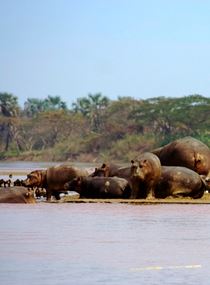 |
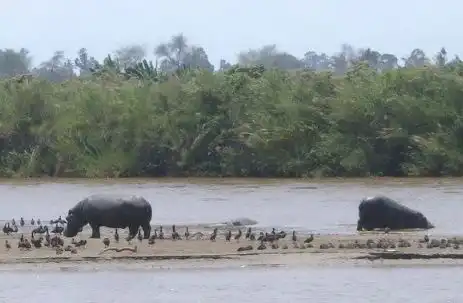
Mammalian fauna includes 19 species including the hippopotamus (Hippopotamus amphibius). We also encounter Tragelaphus scriptus, Tragelaphus spekei; the latter is increasingly threatened. |
The very rich birdlife includes 350 sedentary and migratory species. The sandbanks in the river and in the Delta serve as daytime rest for large groups of Dendrocygna viduata and Dendrocygna bicolor, whose population can reach even 6,000 individuals in July.

|
The exempt grasslands of the Delta are nesting sites for numerous shorebirds such as Himantopus himantopus, Vanellus coronatus. The Hyphaene forest is home to a fairly specific avifauna with characteristic birds such as Cycladusa arquata and Cypsiurus parvus. Apart from resident birds, the park is important as a place of passage, rest and hibernation for intra-African and Palearctic migratory birds. The most important migratory movement observed in the Rusizi plain is constituted by palearctic migrants.
Studies on the reptiles in the Park give 12 species, the most abundant of which are Crocodilus niloticus and Pelusios castaneus. Studies on fish in the Park show 44 species from the Rusizi River and 11 species in the Gatumba ponds with characteristic Protopterus aethiopicus.
The mouth of the Rusizi is a breeding ground for several species of fish from Lake Tanganyika. For amphibians, the inventory carried out at the Delta level gives 17 species divided into 5 families, the most abundant of which are Ranidae and Hyperoliidae. Given its current dimensions, the Rusizi National Park no longer deserves to be called a Park, but rather a Managed Reserve. A project to reduce this Park to 5280 ha is also under study.