Protected Area
Protected Area
Published on
2020 Mar 30Ruvubu National Park
Long used as a hunting area, it was not until 1976 that discussions began for its classification as a national park. As early as 1982, cement bollards were installed to demarcate it. In addition, staff were gradually assigned to the park from January 1984 to January 1989 after two 2 years of procedures for the expropriation and displacement of the inhabitants of the area established as a national park, from 1982 to 1984.
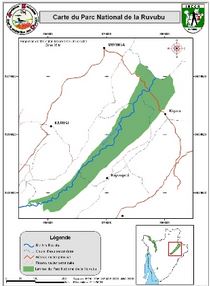 |
The Ruvubu National Park is located in eastern Burundi. It occupies an area of approximately 50,900 ha, at altitudes between 1350 and 1836 m. It extends over 62 km along its main axis, oriented from South-West to North-East. Its width varies between 5 km and 13 km near the Tanzanian border. This park is stretched along the Ruvubu River that gave it its name (Ruvubu meaning the “hippopotamus river”), forming a kind of corridor bounded on both sides by high reliefs. Its relief is very contrasting, alternating mountain ranges, hilly areas, deep ravines and small plains. |
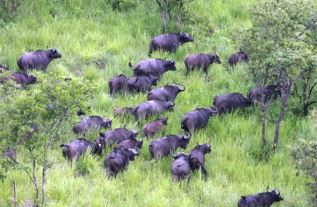 |
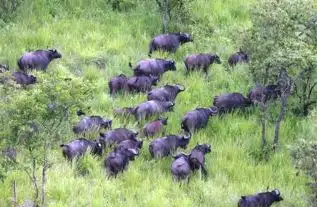
From a wildlife point of view, the park contains 44 species of mammals. The large populations concern species such as the Hippopotamus (Hippopotamus amphibius), the Buffalo (Syncerus caffer), the Cob Defassa (Kobus ellisiprymnus defassa), the Harnessed Guib (Tragelaphus scriptus), the Sitatunga (Tragelaphus scriptus), the Sitatunga (Tragelaphus spekei), the Grimm's Cephalophus (Cephalophus grimmia), the Redunca, the Warthog (Phacochoerus aethiopicus). Major predators include the Panther (Panthera pardus) and the striped-sided jackal (Canis adustus). | 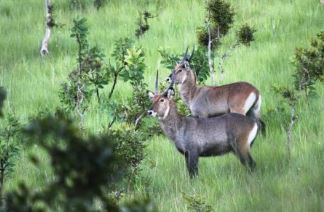 |
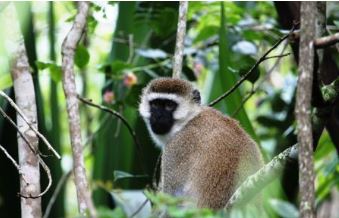 |
Three species of Primates are represented there. A list of 421 species of birds in the park is compiled. Aquatic avifauna is rich and typical of aquatic environments in eastern and southern Africa such as Ardeola rufiventer. Savannah avifauna includes typical Zambezian elements such as Sunbird amethyst, Monticola angolensis, etc... Forest avifauna includes mountain elements such as Trichastoma pyrrhopterum. Vultures have become rare. The aquatic avifauna is relatively rich and diverse with more than 200 different species listed including: four species of touracos, the Spoonbill, the Jabiru and the Denham's Bustard. For reptiles, the crocodile (Crocodilus niloticus) is the most observed. Ophidians are also numerous and more than 9 species have been inventoried. An inventory of 14 species of fish was also made and the genus Barbus is the most represented. |
An inventory made on amphibians indicates the presence of species such as Ptychadena uzunguensis, Ptychadena loveridgei, Bufo maculatus, etc. An inventory made on amphibians indicates the presence of species such as Ptychadena uzunguensis, Ptychadena loveridgei, Bufo maculatus, etc.
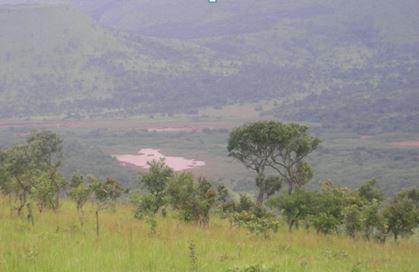 |
As vegetation, we find wooded savannas with Parinari curatellifolia, shrubby and tree-like savannas with Parinari curatellifolia, Pericopsis angolensis and Hymenocardia acida, grassy savannas, forest galleries and marshes with Cyperus papyrus and small and medium-sized Cyperaceae. This vegetation remains poorly studied and only 300 species are reported without being exhaustive. |