Technical and Scientific Cooperation

The uM Basin is partially covered by the Malagarazi Nature Reserve (MNR: Burundi), the latter largely corresponding to the Muyovozi Marshland complex of Burundi [3,6] (Figure 1). Furthermore, the middle Malagarazi (mM) Basin corresponds to the central stretch of the Malagarazi Basin, consisting mainly of floodplains, and extends downstream to the last rapid region below the Igamba Falls, i.e., near the village of Kasagwe (Tanzania), being at about 800 m of altitude (Figure 1). The mM Basin is partially cove
Type de document
Publication
Date de publication (du fichier / URL)
18 juillet 2024

The upper Malagarazi (uM) Basin is situated in Southeastern Burundi and Northwestern Tanzania, and partially covered by the Malagarazi Nature Reserve (MNR). A checklist of fishes from the uM, in Burundi, is presented based on a literature review, a re-examination of historical collections, and a
CAGE FISH FARMING POLICY  FOR THE  EAST AFRICAN COMMUNITY
Type de document
Working document
Date de publication (du fichier / URL)
1 septembre 2021
The Cage Fish Farming Policy (CFF Policy) for the EAC was prepared to fulfil obligations in Article 114 of the EAC Treaty and Article 2 of the LVFO Convention to harmonize policies for joint economic development among the EAC Partner States. Its preparation was guided by the EAC Principle of Subsidiarity, where issues to be addressed jointly within the EAC system originate from the national level, are agreed upon and harmonized at a regional level, and adopted and implemented at a national level. The evolution of the EAC CFF Policy benefited from consultations made with members of the Regional Aquaculture Working Group (ARWG) whose constructive comments and guidance shaped this policy. I also wish to acknowledge with sincere thanks staff of the LVFO Secretariat for the invaluable support they rendered during the entire period of preparation of this document Special thanks go to delegates from EAC Partner States, who constituted the Regional Team of Experts, for their active participation and invaluable contributions during the two Regional Validation Workshops, one in Arusha Tanzania on 2nd June 2021 and the second in Bujumbura, Burundi on the 21st June, 2021. Last but not least I would like to extend my sincere gratitude to all contributors who made valuable comments that improved this document ; we all helped to shape up the CFF Policy document.
Paysage type du Burundi
-

En dates du 19 au 20 août 2026, à l’Université du Burundi, Campus Mutanga, dans la salle de l’EANSI est prévu un Colloque sur la Biodiversité et sécurité alimentaire au Burundi, 2026. Le colloque est organisé par l’université du Burundi via ses centres de recherche (CRAVE, CRSNE, CURSA, CREDSR et

Type de document
Report
Date de publication (du fichier / URL)
5 décembre 2024

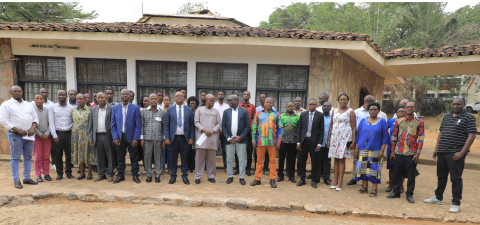
En date du 5 décembre 2024, à l’hôtel Dolce Vita de Kigobe, à Bujumbura, s’est tenue une séance de formation des Points focaux interinstitutionnels du CHM-Burundi organisée dans le cadre du Projet « CHM-OBPE» du Programme de recherche, d’échange d’information, de sensibilisation et de conservation

La situation mondiale de la santé animale
Type de document
Report
Date de publication (du fichier / URL)
1 janvier 2025
La santé animale est indissociablement liée à la santé humaine, à la stabilité des écosystèmes et à la robustesse des économies. Dans un monde confronté à des défis globaux de plus en plus complexes – maladies infectieuses émergentes, chan gemment climatique, résistance aux antimicrobiens et insécurité alimentaire – assurer la santé des animaux est crucial. Cette première édition du rapport sur la Situation Mondiale de la Santé Animale est une publication phare publiée par l’Organisation Mondiale de la Santé Animale (OMSA) à l’occasion de sa 92e session générale de l’Assemblée mon dial, reflétant notre engagement envers la prise de décision fondée sur des preuves et l’action basée sur les données. S’appuyant sur les systèmes d’information complets de l’OMSA et l’expertise collective de ses Membres et de son réseau d’experts, ce rapport offre une analyse claire, objective et opportune du paysage mondial de la santé animale, nous aidant à comprendre la situation actuelle et le chemin vers un avenir plus sain
Type de document
Working document
Date de publication (du fichier / URL)
17 novembre 2023

Contexte

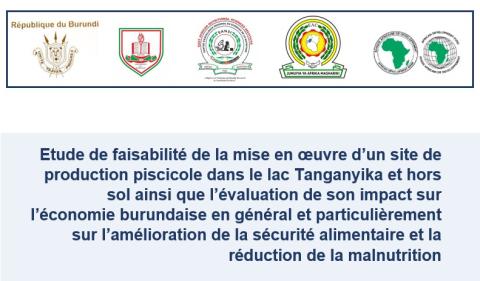
Le lac Tanganyika constitue une ressource naturelle stratégique pour les pays riverains, dont le Burundi. Il joue un rôle essentiel dans la sécurité alimentaire, les moyens de subsistance des populations et la conservation de la biodiversité aquatique. Toutefois, cette ressource fait

Type de document
Report
Date de publication (du fichier / URL)
25 septembre 2025
Type de document
Report
Date de publication (du fichier / URL)
21 août 2024